
What is it?
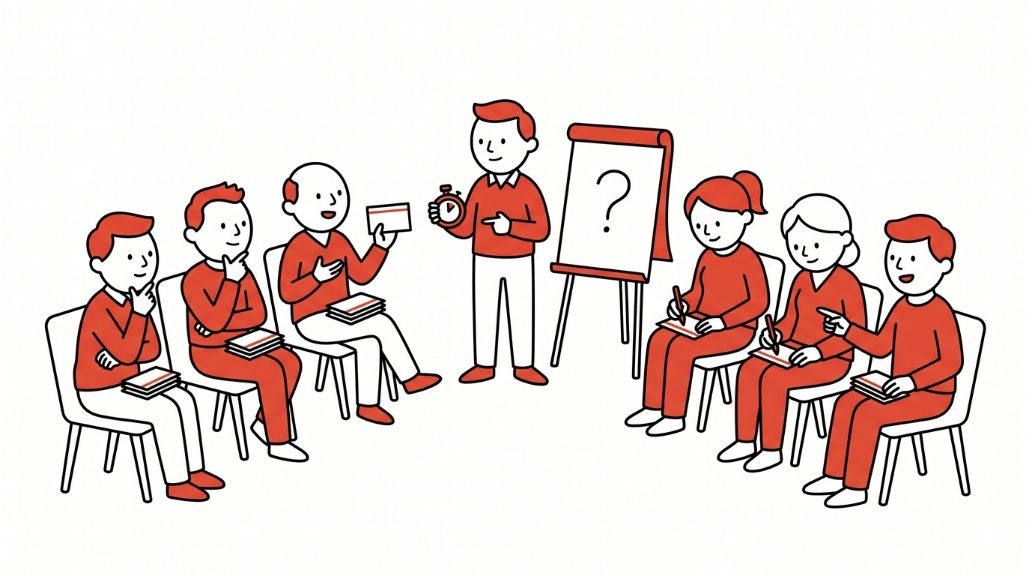
15% Solutions is a short, focused exercise where each person in a group identifies the actions they can take right now, using only the resources and authority they already have. Instead of waiting for permission, more budget, or a grand plan, participants zero in on what is within their personal control. They write down their own small steps, then share them with a small group who help sharpen and strengthen each idea. The result is a room full of people who leave with at least one concrete thing they can do tomorrow, no approval needed.
Also Known As
- 15 Percent Solutions
When to Use It
- After a big discussion that has generated lots of ideas but no clear next steps, and the group needs to move from talking to doing
- When a team feels stuck or overwhelmed by the size of a challenge and needs to find the first small actions they can control
- At the end of a workshop, planning session, or strategy day to convert insights into individual commitments
- When there is a gap between what people know they should do and what they are actually doing
- After a retrospective or review to shift from "what should we do differently" to "what will I do differently, starting now"
- When decision-making authority is distributed and you need many small actions happening in parallel rather than one big move
- As a closing structure for any Liberating Structures string, turning shared exploration into personal action
When NOT to Use It
- When the group genuinely has no discretion to act, for example if a decision must come from leadership before anything can move
- When the problem requires a single coordinated response rather than distributed individual action
- When the group has not yet explored the challenge enough to know what actions would be useful; running 15% Solutions too early can produce superficial commitments
- When people are too exhausted or cynical to engage honestly; the exercise relies on genuine personal reflection, and going through the motions produces empty lists
- When accountability structures are missing and there is no follow-up mechanism; without follow-through, the exercise becomes another list that gets forgotten
15% Solutions was developed as a Liberating Structure by Henri Lipmanowicz and Keith McCandless, inspired by the work of Professor Gareth Morgan. Morgan, together with Asaf Zohar at York University, introduced the concept through their 1998 article "The 15% Approach: Quantum Change Incrementally!" in the Holland Management Review. Their insight was that most significant organisational changes happen not through grand transformation programmes but through small, high-leverage decisions made by individuals within their existing sphere of influence.
What You Need
Group size: 2 to any number. Works with small teams of 4 and scales to large groups of 200+. The individual reflection scales without limit; the consultation rounds work best in groups of 2 to 4.
Time required:
- 20 minutes minimum (tight but workable)
- 30 minutes is typical and allows proper consultation
- 45 minutes for a deeper version with extended peer coaching.
Space:
- Chairs arranged so people can sit in groups of 2 to 4
- No tables required, though they can help if people want to write
- Enough space for the room to feel relaxed rather than cramped
Materials:
- Index cards or sticky notes for each participant (one per person minimum, two or three is better)
- Pens for everyone
- A timer visible to the facilitator
- Optional: flip chart or slide with the core question visible throughout
The Process
Setup
- Prepare the invitation question in advance. The standard version is: "What is your 15 percent? Where do you have discretion and freedom to act? What can you do without more resources or authority?" You may want to connect this to a specific challenge the group has been working on.
- Write the question on a flip chart or slide so it stays visible throughout.
- Arrange chairs so people can form small groups of 2 to 4 with minimal fuss. If tables are in the way, consider removing them.
- Have index cards and pens ready to distribute.
Step 1: Frame the Concept
Time: 2 to 3 minutes
Purpose: Help participants understand what a 15% Solution is and why small personal actions matter.
- Explain the concept in plain language: "A 15% Solution is something you can do right now, on your own, without needing more money, more authority, or anyone's permission. It is the part of the problem that sits inside your sphere of influence."
- Give a quick example to make it concrete: "If the challenge is improving customer response times, a 15% Solution might be 'I will reply to every email within two hours this week' rather than 'We should hire more staff.'"
- Stress that this is personal: "We are not looking for what the team should do or what the organisation needs. We are asking what you, individually, will do."
- Make it clear that small is good: "A 15% Solution that you actually do is worth more than a 100% plan that sits on a shelf."
Step 2: Individual Reflection
Time: 5 minutes
Purpose: Give each person quiet time to identify their own 15% Solutions without group pressure or influence.
- Distribute index cards and pens.
- Ask the question: "Think about the challenge we have been discussing. What is your 15 percent? What can you do, starting tomorrow, using only what you already have?"
- Ask people to write down as many 15% Solutions as they can think of. Aim for at least two or three.
- Keep the room silent during this time. Resist the urge to fill the quiet.
Watch for: People writing "we should" instead of "I will." If you notice this, gently remind the group: "Remember, this is about what you personally can do, not what the team or organisation should do."
Step 3: Small Group Consultation
Time: 10 to 15 minutes (3 to 5 minutes per person, depending on group size)
Purpose: Each person shares their 15% Solutions and receives help from peers to make them sharper, smaller, and more doable.
- Ask people to form groups of 2 to 4. Keep it simple: turn to the people nearest you.
- Explain the format: "One person at a time shares their 15% Solutions. The others listen, ask clarifying questions, and offer suggestions to make the actions even more concrete and achievable. You might help someone make their step smaller, or point out a resource they had not considered."
- Give each person 3 to 5 minutes depending on group size. Call time between rounds.
- Useful prompts for the consultants: "What would make this even easier to start?" and "Is there a way to test this in the next 48 hours?" and "What is the smallest version of this you could try?"
Watch for: Groups drifting into general problem-solving rather than sharpening individual actions. If you hear "what we really need is...", redirect them: "Bring it back to what this person can do on their own."
Closing
Time: 3 to 5 minutes
- Ask each person to choose one 15% Solution they commit to acting on. Have them circle it or write it on a fresh card.
- Optional: do a quick whip-round where each person shares their chosen action in one sentence. This creates public commitment without eating up too much time.
- If appropriate, ask people to pair up with an accountability partner who will check in with them at an agreed time: "Find someone in the room who will ask you next week whether you did it."
- Close with a reminder: "A journey of a hundred miles starts with one step. You have just identified yours."
Facilitator Guidance
What Makes This Work
The power of 15% Solutions comes from a shift in attention. Most group discussions focus on what the organisation should do, which puts the locus of control outside the individual. 15% Solutions flips this by asking each person to look at what sits inside their own circle of influence. This shift does two things at once: it removes the excuse of powerlessness ("I cannot do anything until leadership decides") and it surfaces a distributed network of small actions that, taken together, can create significant momentum. The peer consultation round adds a second layer of value. Other people can see possibilities in your situation that you have become blind to, and they can help you shrink an action down to something genuinely doable.
Common Pitfalls
- Letting people stay abstract: The most common failure is 15% Solutions that sound like strategy statements rather than actions. "Improve communication" is not a 15% Solution. "Send a weekly update email to the three teams I work with" is. Push for specificity during the consultation round.
- Skipping the consultation round: Some facilitators treat this as a solo reflection exercise and skip the peer input. The consultation round is where the real sharpening happens. Do not cut it.
- Making the groups too large: Groups of 5 or more slow the process down and reduce the quality of feedback each person receives. Keep it to 2 to 4.
- Using it too early in a session: If the group has not yet explored the challenge in enough depth, their 15% Solutions will be generic. Use this after the group has done real thinking, not as a warm-up.
- No follow-up: If 15% Solutions become a ritual without any follow-through, people stop taking them seriously. Build in a check-in at the next meeting: "What have you done with your 15 percent?"
Adaptations
- Virtual delivery: Use the same structure with breakout rooms of 2 to 4 for the consultation round. Have people type their 15% Solutions in a shared document or on a virtual whiteboard before entering breakout rooms, so others can read them quickly. Use the chat for the final commitment share if time is tight.
- Larger groups (50+): The structure scales well. Individual reflection and small group consultation work the same at any size. For the closing, skip the whip-round and use a written commitment instead, such as posting a sticky note on a wall or typing into a shared board.
- Shorter timeframes (10 to 15 minutes): Cut the individual reflection to 3 minutes and do the consultation in pairs rather than groups of 4. Skip the whip-round closing and go straight to a written commitment.
- Longer timeframes (45 minutes): Extend the consultation round to include a second pass where partners help each other identify potential obstacles and workarounds. Add a planning element where each person maps out their first three days of action.
- As part of a Liberating Structures string: 15% Solutions pairs well with 1-2-4-All (to surface the challenge first), TRIZ (to clear away counterproductive behaviours), Troika Consulting (for deeper peer coaching), and Wise Crowds (for more substantial consultation on complex actions).
Real-World Applications
Post-Strategy Day Commitment: A leadership team spent a full day developing a new customer experience strategy. The facilitator closed the day with 15% Solutions, asking each leader to identify what they could do in their own department without waiting for the full strategy to be approved. Within two weeks, several small improvements were visible across the organisation, creating early momentum that helped build support for the larger plan.
Agile Retrospective Closer: A Scrum Master used 15% Solutions at the end of every sprint retrospective. Instead of the team creating a shared action list that no one owned, each team member identified one personal 15% Solution. Over three sprints, the team noticed that more actions were actually being completed compared to the old shared-list approach.
Cross-Functional Workshop: A hospital brought together nurses, doctors, and administrators to address patient discharge delays. After mapping the problem, the facilitator ran 15% Solutions. Each professional group discovered actions within their own control that they had been waiting for "the system" to fix. The combined effect of 30 individual 15% Solutions reduced average discharge time by 40 minutes within a month.
Teacher Professional Development: A school used 15% Solutions during a staff development day focused on student engagement. Each teacher identified one small change to try in their classroom the following week. At the next staff meeting, teachers shared what they had tried, creating a peer learning cycle that continued throughout the term.
New Manager Onboarding: An L&D team built 15% Solutions into their management development programme. After each module, new managers identified their personal 15% Solutions and paired up with an accountability partner from the cohort. The pairing created ongoing peer support that extended well beyond the formal programme.