
What is it?
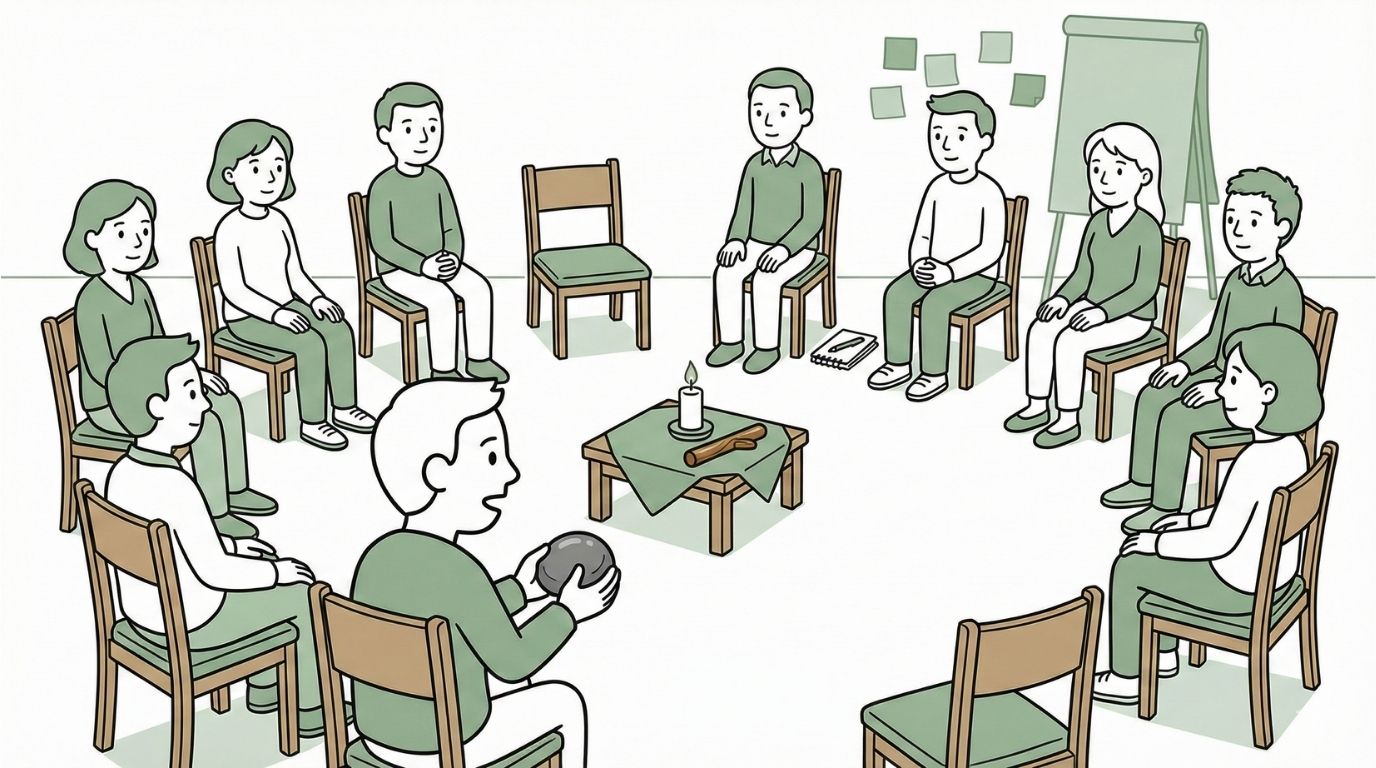
Circle Practice is a structured dialogue method where a group sits in a circle and speaks one at a time, guided by a talking piece that passes from person to person. Only the person holding the talking piece speaks. Everyone else listens. There is no cross-talk, no debate, and no interrupting. The result is a quality of conversation most groups have never experienced: slower, deeper, and more honest than typical meetings. It strips away the usual power dynamics and replaces them with a shared commitment to speaking from the heart and listening without judgement.
Also Known As
- Council Practice
- Talking Circle
- Circle Way
When to Use It
- A team needs to rebuild trust after conflict, restructuring, or a difficult period
- You want to surface perspectives that are being suppressed by dominant voices or hierarchy
- The group is facing a significant transition and needs space to process what it means for them
- You need genuine buy-in on a decision, not just compliance
- A project post-mortem or retrospective keeps producing surface-level feedback
- Opening or closing a multi-day event where depth of connection matters
- The group has been stuck in circular debate and needs a different mode of communication
- Cross-cultural or cross-hierarchical groups need a level playing field
When NOT to Use It
- The group needs to make a quick operational decision. Circle is for depth, not speed.
- Participants are not willing to sit with silence or slow down. Forcing circle on a resistant group backfires.
- The group is larger than about 20 people. Beyond that, waiting time becomes frustrating and engagement drops.
- There is active, unresolved interpersonal hostility that needs mediation first. Circle can hold tension, but it is not a substitute for conflict resolution.
- You need structured problem-solving or idea generation. Circle produces understanding, not action plans.
- The facilitator has not practised holding silence themselves. If you are uncomfortable with pauses, the group will feel it.
Circle Practice draws from Indigenous traditions across many cultures, where sitting in circle with a talking piece has been used for community dialogue, decision-making, and ceremony for thousands of years. The modern facilitation form was shaped by Christina Baldwin and Ann Linnea, who founded PeerSpirit in the 1990s and codified the practice in their book Calling the Circle: The First and Future Culture (1998). Their work made circle accessible to organisations, schools, and communities while honouring its roots. The practice has also been influenced by the Council tradition developed at the Ojai Foundation in California during the 1980s.
What You Need
Group size: 6-16 is ideal. Works with as few as 4. Beyond 20, consider splitting into multiple circles.
Time required: Minimum 30 minutes for a focused single-round circle. Typical session runs 60-90 minutes with multiple rounds. Extended circles can run half a day for deep work.
Space:
- A room where chairs can be arranged in a single circle with no tables between participants
- Enough space that people are not crammed together but close enough to feel connected
- Minimal distractions: no screens, no passing foot traffic, ideally a door that closes
- A small table or cloth in the centre of the circle for the talking piece (optional but grounding)
Materials:
- A talking piece: any object that feels right for the group. A stone, a stick, a ball, a meaningful object. It should feel good to hold and have some weight to it.
- A bell, chime, or singing bowl for signalling transitions (optional but useful)
- A printed copy of the circle agreements for each participant or displayed on a flip chart
- A timer or watch (for the facilitator only)
The Process
Setup
- Arrange chairs in a circle. Remove tables. Make sure every chair is part of the circle with no one sitting behind or outside.
- Place the talking piece on a small table or cloth in the centre. If you have a candle, flowers, or other centrepiece, set those out too. This is not decoration; it gives the group something to focus on during silence.
- Test the room for comfort. Can everyone see each other? Is the circle tight enough to feel connected but loose enough that no one feels trapped?
- Prepare your circle agreements on a flip chart or handout. The core agreements are: speak with intention, listen with attention, tend to the wellbeing of the group, and trust the process.
- If this is the group's first circle, prepare a short explanation of the practice and a low-stakes opening question.
Step 1: Welcome and Framing
Time: 5-10 minutes
Purpose: Set the tone and establish the container that makes circle work.
- Invite everyone to sit down and take a moment to arrive. Allow 30 seconds of silence.
- Explain the practice briefly: "We are going to have a conversation using a talking piece. When you hold this, you speak. When you do not hold it, you listen. There is no cross-talk, no responding to what someone said, no debate. You speak what is true for you and you listen to what is true for others."
- Introduce the circle agreements. Walk through each one:
- "Speak with intention: say what matters, not what fills space."
- "Listen with attention: focus on the speaker, not on what you want to say next."
- "Tend to the wellbeing of the group: be aware of time and energy. If you have spoken at length, make space. If you have been quiet, consider contributing."
- "Trust the process: it may feel slow or awkward. That is normal. Stay with it."
- Ask the group if they can commit to these agreements. Wait for verbal or visual confirmation. Do not rush past this.
- Explain how the talking piece will move. You can pass it clockwise, counter-clockwise, or place it in the centre for people to pick up when moved to speak (called "popcorn" style). For first-time groups, passing in sequence is easier.
Watch for: Nervous laughter or eye-rolling. This is normal. Name it: "Some of you might be thinking this feels a bit unusual. That is fine. Let's try it and see what happens."
Step 2: Check-In Round
Time: 10-20 minutes (depending on group size)
Purpose: Get every voice into the room and let people practise using the talking piece on something low-stakes.
- Offer a simple opening question. Good options include: "What is one thing you are bringing into this room today?" or "What do you need to let go of to be fully here?" or "What is alive for you right now?"
- Pick up the talking piece. Model the behaviour you want: speak briefly, honestly, and from your own experience. Then pass the piece to the person next to you.
- Let the piece travel around the full circle. Every person either speaks or holds the piece in silence for a moment and passes it on. Make clear that passing without speaking is always acceptable.
- When the piece returns to you, acknowledge the round: "Thank you. Now we have heard from everyone."
Watch for:
- People who talk for several minutes on the check-in. Gently set expectations before starting: "Aim for a minute or two each."
- Someone who freezes. Do not rush them. Wait. The group learns patience from these moments.
Step 3: Core Round(s)
Time: 30-50 minutes (one to three rounds depending on depth needed)
Purpose: This is where the real work happens. The group explores the central question or theme.
- Introduce the core question. Frame it carefully. Good circle questions are open, personal, and invite honest reflection. Examples: "What is the hardest thing about how we work together right now?" or "What would it take for you to feel genuine ownership of this change?" or "What are we not saying to each other that needs to be said?"
- Pause after stating the question. Give people 30-60 seconds to think before the talking piece begins to move.
- Place the talking piece in the centre or hand it to someone to begin. For deeper topics, popcorn style (picking up from the centre) works better because it lets people speak when they are ready rather than when the piece arrives.
- Hold the space. Your job now is to listen, watch body language, and trust the process. Do not comment between speakers. Do not summarise. Do not redirect.
- If a second or third round is needed, pause between rounds. Name what you are noticing without interpreting: "I notice we have been circling around the question of trust. Let's go around again with this in mind."
- If someone breaks the agreements by responding to another speaker or debating, gently intervene: "Let's come back to the practice. Hold your response and speak from your own experience when the piece reaches you."
Watch for:
- Long silences where no one picks up the talking piece. Let the silence last longer than feels comfortable. Often the most important things are said after the group sits through discomfort.
- One person dominating. After two or three rounds, if the same voices are taking the most space, you might say: "For this next round, I'd invite those who have spoken less to pick up the piece first."
- Emotional moments. If someone becomes tearful or their voice cracks, do not rush to comfort or move on. Let the circle hold them. A brief silence after someone shares something vulnerable is a gift, not a problem.
Step 4: Reflection Round
Time: 10-15 minutes
Purpose: Allow the group to make meaning of what they heard without slipping into debate.
- Introduce the reflection question: "Having listened to everyone, what stands out to you? What surprised you? What do you want to take with you from this conversation?"
- Pass the talking piece around the full circle one more time.
- This round tends to be shorter and more focused. People often name patterns they heard, express gratitude, or state a personal commitment.
Closing
Time: 5 minutes
- When the final round is complete, take the talking piece and offer a brief closing. Keep it short: "Thank you for being willing to slow down and listen to each other. What was said here stays here unless we agree otherwise."
- If you set a confidentiality agreement, restate it now.
- Ring the bell or chime if you have one. This gives the group a clear sensory signal that the circle is complete.
- Allow a moment of silence before people stand up or start talking.
Facilitator Guidance
What Makes This Work
Circle works because of constraint. By removing the ability to respond, debate, or build on what others say, you force each person to speak from their own experience rather than positioning against someone else. The talking piece is not a gimmick; it physically transfers authority to speak. This levels hierarchy in a way that verbal instructions alone cannot. When a junior team member holds the same object as the CEO, and the CEO is required to listen in silence, the power dynamic shifts. The slowness is the point. People who are used to fast-paced meetings find that the slower pace surfaces thoughts and feelings they did not know they had. The practice also builds a specific kind of trust: the trust that comes from being heard without being judged or fixed.
Common Pitfalls
- Rushing the setup: If you skip the agreements or breeze through the explanation, the group will not know how to hold the practice. Spend the time upfront. It pays off.
- Intervening too much: New circle facilitators tend to fill silences, summarise, or comment between speakers. Resist this. Your restraint teaches the group how to hold space.
- Choosing weak questions: If the question is too safe ("What do you appreciate about the team?"), the circle will stay shallow. If it is too confrontational for a first circle, people shut down. Match the question to the group's readiness.
- Using circle for decisions: Circle is a dialogue method, not a decision-making method. If the group expects to leave with a decision, they will be frustrated. Be clear about the purpose from the start.
- Ignoring confidentiality: What is shared in circle is often more personal than typical meeting content. If you do not set a clear confidentiality agreement, people will hold back.
- Choosing the wrong talking piece: A pen, a phone, or something flimsy undermines the practice. Choose something with weight and presence. If possible, let the group choose or contribute the object.
Adaptations
- Virtual/remote delivery: Use a virtual talking piece by calling names in sequence or using a "raise hand" function as a signal. Mute all participants except the current speaker. It is slower and harder to read the room, but it works if the group is committed. Consider using a visual object on screen that you "pass" by naming the next person.
- Larger groups (20-40): Split into multiple circles of 8-12, each with a facilitator. Bring the full group back together for a single closing round where one representative from each circle shares a theme.
- Shorter timeframes (20-30 minutes): Use a single round with a focused question. Works well as a check-in or check-out for longer sessions.
- Longer deep-dive (half day or full day): Alternate between circle rounds and solo reflection or walking time. Build in three to four core rounds with increasing depth.
- Organisational settings: Frame it as "structured listening" rather than "circle practice" if the language feels too unfamiliar for the culture. The mechanics are the same.
- Opening or closing a retreat: A single check-in circle at the start of a multi-day event sets a tone that carries through everything that follows. A closing circle gives people a way to name what mattered.
Real-World Applications
Leadership team after a restructure: A newly formed leadership team of 12 used circle to talk about what they had each lost and gained in the restructure. The conversation surfaced resentment and grief that had been driving passive-aggressive behaviour in meetings. Two rounds of honest sharing did more for team cohesion than three months of regular meetings had.
Cross-departmental project friction: Two departments that had been blaming each other for missed deadlines sat in circle with the question "What is it like to do your job right now?" Hearing colleagues describe their daily reality without the opportunity to defend or explain shifted the dynamic from blame to empathy.
Annual strategy offsite opening: A consulting firm used a 20-minute check-in circle to open their annual strategy day. Partners who typically dominated discussions heard from associates for the first time. The quality of conversation for the rest of the day was noticeably different.
School staff wellbeing session: A headteacher ran a monthly circle for teaching staff with the question "What is one thing that is weighing on you?" Teachers reported that the 30-minute session was the only time they felt genuinely listened to by colleagues. Staff retention improved over the year.
Post-incident debrief in healthcare: A hospital ward used circle after a critical incident to allow every team member, from consultants to healthcare assistants, to share their experience. The talking piece meant that voices usually drowned out by hierarchy were heard for the first time. The team identified systemic issues that a standard debrief had missed.