
What is it?
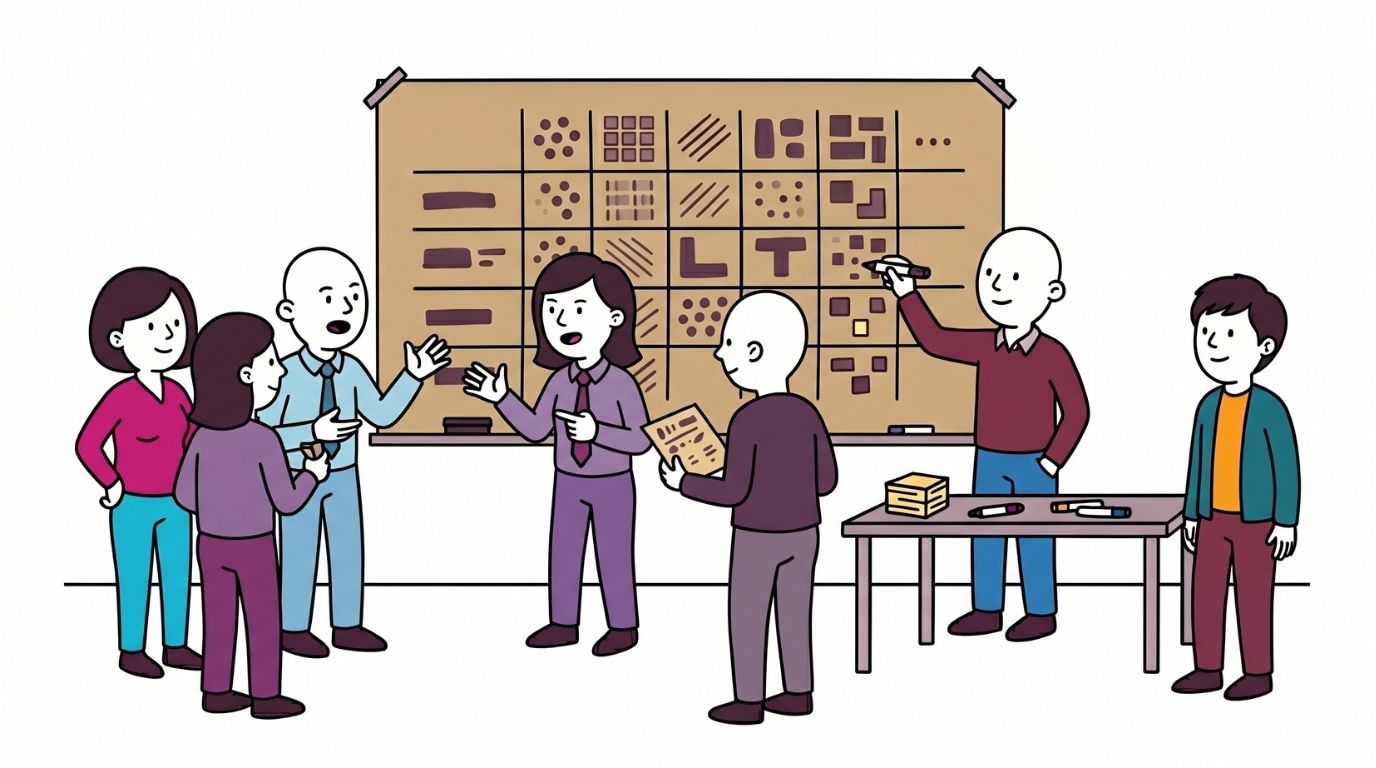
A Decision Matrix is a structured scoring tool that helps a group compare several options against a set of criteria, usually with weights attached to reflect what matters most. The group builds a simple grid: options down one side, criteria across the top. They score each option against each criterion, multiply by the weight, and add up the totals. The highest score points to the strongest candidate. The real value is not the number at the end. It is the conversation that happens when people have to agree what the criteria are, what each one is worth, and how each option actually performs. The tool makes thinking visible and forces a group to talk about trade-offs they might otherwise dodge.
Also Known As
- Weighted Decision Matrix
- Criteria Matrix
- Pugh Matrix
- Pugh Method
- Pugh Concept Selection
- Selection Grid
- Criteria Rating Form
- Solution Matrix
- Decision Grid
When to Use It
- The group has a shortlist of three to six options and needs to pick one or narrow down further
- Multiple criteria matter and they are not equally important
- The decision involves trade-offs that people are arguing about in circles
- You need a decision trail to show stakeholders how and why a choice was made
- A vocal minority is dominating and you want to slow the group down and hear from everyone
- You want to stress-test a front-runner before committing
- The group is choosing between vendors, suppliers, locations, designs, or strategic directions
- A previous gut-feel decision went wrong and people want more rigour next time
When NOT to Use It
- The group only has one or two viable options (just compare them directly)
- Time is so short that people will score without thinking
- The decision is fundamentally about values or relationships, not features
- Data to inform scoring does not exist and guesses will dominate
- The group has not yet generated enough options (go back to divergent thinking first)
- Someone in the room has the authority and will to decide, and a matrix would be theatre
- The decision is reversible and cheap, so fast experimentation beats careful analysis
- The real problem is disagreement about the goal itself, not which option best meets it
The Decision Matrix method was developed by Stuart Pugh, a British design engineer, and published in his 1991 book Total Design: Integrated Methods for Successful Product Engineering. Pugh created it to help engineering teams compare competing design concepts in a systematic way. The technique has since spread well beyond product design into Six Sigma, business analysis, procurement, and general group decision-making. Earlier forms of criteria-weighting tables existed in operations research from the 1960s onwards, but Pugh's version is the one most facilitators recognise today.
What You Need
Group size: Works best with 4 to 12 people. Smaller groups move faster. Larger groups need to split into sub-teams for scoring, then compare.
Time required:
- 60 minutes for a simple decision with three options and four criteria
- 90 to 120 minutes for most real decisions
- Half a day if the criteria themselves need debate.
Space:
- A room with wall space for a large matrix or a table big enough for everyone to see the grid
- Good lighting so scores are easy to read from across the room
Materials:
- Flip chart paper, whiteboard, or large brown paper to draw the matrix
- Marker pens in at least two colours (one for structure, one for scores)
- Sticky notes for options and criteria so they can be moved around
- Calculator or a laptop with a spreadsheet open
- Printed scoring slips if you want people to score individually before sharing
- A pre-drawn scoring scale reminder (e.g. 1 = poor, 5 = excellent) stuck on the wall
The Process
Setup
- Clarify with the decision owner what question the matrix needs to answer. Write it on a flip chart at the front of the room.
- Confirm that the group has the right people to score. You need domain knowledge on the criteria. If the expertise is missing, delay or invite someone else in.
- Check that options are real. Weak or half-baked options waste the group's time.
- Decide in advance whether you will use a baseline (Pugh's original approach) or simple weighted scoring. Weighted scoring is more common in workshops.
- Draw the empty matrix on the wall or board before the group arrives, or prepare a template in a shared document if running hybrid.
Step 1: Frame the decision
Time: 5 to 10 minutes
Purpose: Make sure everyone is answering the same question.
- Read the decision question out loud and ask the group to confirm they agree with the wording.
- Check that all options are visible and understood. Say: "Does anyone need an option explained before we go further?"
- Set the ground rule that this matrix informs the decision but does not automate it. The group will still discuss the result.
- Explain the scoring scale you will use (typically 1 to 5, or -1 / 0 / +1 for a Pugh-style baseline comparison).
Step 2: Generate the criteria
Time: 15 to 20 minutes
Purpose: Agree what matters when judging these options.
- Ask: "What do any of these options need to deliver for us?" Give people two minutes of silent thinking with sticky notes.
- Have each person read their notes out and place them on the wall. Group duplicates as you go.
- Push for criteria that discriminate between options. If every option will score the same on a criterion, it does not help the decision.
- Cap the list at six to eight criteria. More than that and the scoring becomes noise.
- Word each criterion so that higher is always better. Use "ease of implementation" not "difficulty" and "speed to market" not "time to launch". This stops scores running in opposite directions.
Watch for:
- People sneaking their preferred option's strengths into the criteria list. Notice this and name it gently.
- Criteria that are really two things mashed together (e.g. "cost and risk"). Split them.
Step 3: Weight the criteria
Time: 10 to 15 minutes
Purpose: Reflect the fact that some criteria matter more than others.
- Give every person ten points to distribute across the criteria. They can put all ten on one if they feel strongly, or spread them thinly.
- Collect the points for each criterion and add them up. This is the rough weight.
- Show the weights to the group. Ask: "Does this reflect how we think about this decision?"
- Adjust if needed. Common adjustment: if cost or time is dominating because it is concrete, ask whether quality or fit is being underweighted because it is harder to measure.
- Convert to a simple 1 to 5 scale if that makes the maths easier. Lock the weights before scoring begins.
Watch for:
- People gaming the weights to favour their preferred option. If you suspect this, do weights blind (private scoring, revealed together).
Step 4: Score each option against each criterion
Time: 20 to 40 minutes
Purpose: Build a shared picture of how each option performs.
- Work one criterion at a time, not one option at a time. This reduces the halo effect where a favourite option gets high scores on everything.
- For each option on that criterion, ask the group to score individually first (on paper or sticky note), then share.
- If scores vary by more than two points, stop and have the outliers explain. This is where the real learning happens.
- Say: "Talk me through why you gave that a 2 when others said 4?" and "What would change your score?"
- Agree a single score by discussion, not by averaging. Averaging hides the disagreement.
- Write the score in the cell and move on. Resist the urge to keep revisiting early cells.
Watch for:
- A dominant voice anchoring the first score and everyone else sliding towards it. Use silent individual scoring first every time.
- Score creep where everything gets a 4 because the group is being polite. Force at least one low score somewhere if options genuinely differ.
Step 5: Calculate and review the totals
Time: 10 to 15 minutes
Purpose: Convert the scores into a comparable result and test it against intuition.
- Multiply each score by its weight. Add up each column to get a total for each option.
- Write the totals in bold at the bottom of the matrix.
- Ask: "Looking at this, what does the result say to you?" Wait. Let the group sit with it.
- Then ask: "Does the winning option feel right?" If the answer is "yes, obviously", the matrix has confirmed the group's thinking. If "no, something is off", that is a useful signal and the group should investigate.
- Look at the profile, not just the total. An option that scores evenly across all criteria is different from one that wins overall but scores badly on something important.
- Check for "must haves" that slipped through as weights. If an option fails a must-have criterion, it should be removed regardless of its total.
Watch for:
- A winner by a narrow margin. Treat this as "too close to call" and do a sensitivity check: change one weight or score and see if the winner flips. If it does, you do not have a decision yet.
Closing
Time: 10 to 15 minutes
- Summarise the decision or recommendation in one sentence and read it back to the group.
- Capture the key trade-offs in the decision. What is the group accepting about the chosen option?
- Name any concerns that are not going away and agree how you will monitor them after the decision takes effect.
- Agree who owns the next step and when. Without this, the matrix ends as an exercise, not a decision.
- Thank the group for the honesty of their scoring. People often find it harder than they expected.
Facilitator Guidance
What Makes This Work
A Decision Matrix works because it breaks a fuzzy, argumentative question into a sequence of smaller questions the group can actually answer. By separating "what matters?" from "how important is each thing?" from "how does each option perform?", it stops people leaping straight to their preferred answer and arguing backwards to justify it. The arithmetic is not the point. The conversation each cell forces is. A matrix will not produce a good decision on its own, but it will surface the assumptions a group is making and give them somewhere to be challenged.
Common Pitfalls
- False precision: A score of 4.3 feels scientific but is usually a guess dressed up in a decimal. Round to whole numbers and remind the group that these are judgements, not measurements.
- Criteria as smokescreen: A team turns up with a favourite option and builds criteria that happen to favour it. Generate criteria before anyone mentions options, or at least before scoring starts.
- Halo effect on the favourite: One person loves Option B and scores it high on everything, including criteria where it objectively performs worse. Score one criterion at a time across all options, not one option at a time.
- Skipping the weighting debate: Weighting is where values collide. Rushing it produces a matrix everyone mistrusts. If weighting takes 30 minutes of argument, that is time well spent.
- Treating the result as the decision: The matrix informs the decision. It does not make it. The decision still belongs to whoever has the authority to make it.
- Using it as a shield: A manager runs a matrix to avoid owning a decision. The group scores, the "numbers decide", and no-one is accountable. Call this out early.
- Ignoring the must-haves: Something that fails a non-negotiable criterion cannot be redeemed by a high overall score. Flag must-haves clearly and apply them as filters before the weighted scoring.
Adaptations
- Virtual/remote delivery: Use a shared spreadsheet or a collaborative whiteboard tool. Use breakout rooms for individual scoring, then come back together to discuss variance. Visible disagreement is harder online, so make space for silent cues (chat, reactions).
- Larger groups: Split into sub-teams of three or four, each scoring the same matrix, then compare. Differences between sub-teams often reveal different assumptions.
- Quick version (20 minutes): Skip the weighting step, use +1 / 0 / -1 scoring against a baseline option (Pugh's original approach). Good for early-stage concept screening.
- High-stakes version (half day): Add a sensitivity analysis stage where the group tests what happens when weights or scores shift. Good for decisions that will be scrutinised later.
- Blind scoring: Each person scores alone on paper, scores are revealed together, and any variance of three or more triggers discussion. Reduces anchoring in senior-heavy groups.
Real-World Applications
Choosing a new CRM: A sales team of eight compares four CRM platforms. They weight integration with their existing tools highest, followed by reporting, then price, then training time. The scoring reveals the cheapest option would actually cost more in integration effort. They choose the second-highest scorer, which wins on integration, saving six months of rework.
Selecting a conference venue: A five-person events team scores five venues against cost, travel time, capacity, catering quality, and atmosphere. The favourite at the start scores poorly on capacity once they check numbers properly. The matrix shifts them to a venue no-one had championed, which turns out to be the best fit.
Prioritising product features: A cross-functional product group uses a simplified matrix to rank twelve features against customer value, development effort, and strategic fit. Weighting forces them to agree what "strategic fit" actually means, which was the real problem. Three features move up the roadmap, four drop off entirely.
Picking a new office location: A leadership team of six scores three possible locations against staff commute, client proximity, cost per square foot, growth capacity, and landlord flexibility. The winner was the third choice going in. The group leaves with a decision and, equally important, a record of the trade-offs they have accepted.
Choosing between change programme designs: An HR team evaluates three proposed approaches to a culture change initiative against leader engagement, speed, cost, and sustainability. The matrix exposes that their preferred approach scores badly on sustainability, which was meant to be the whole point. They rework it before committing.