
What is it?
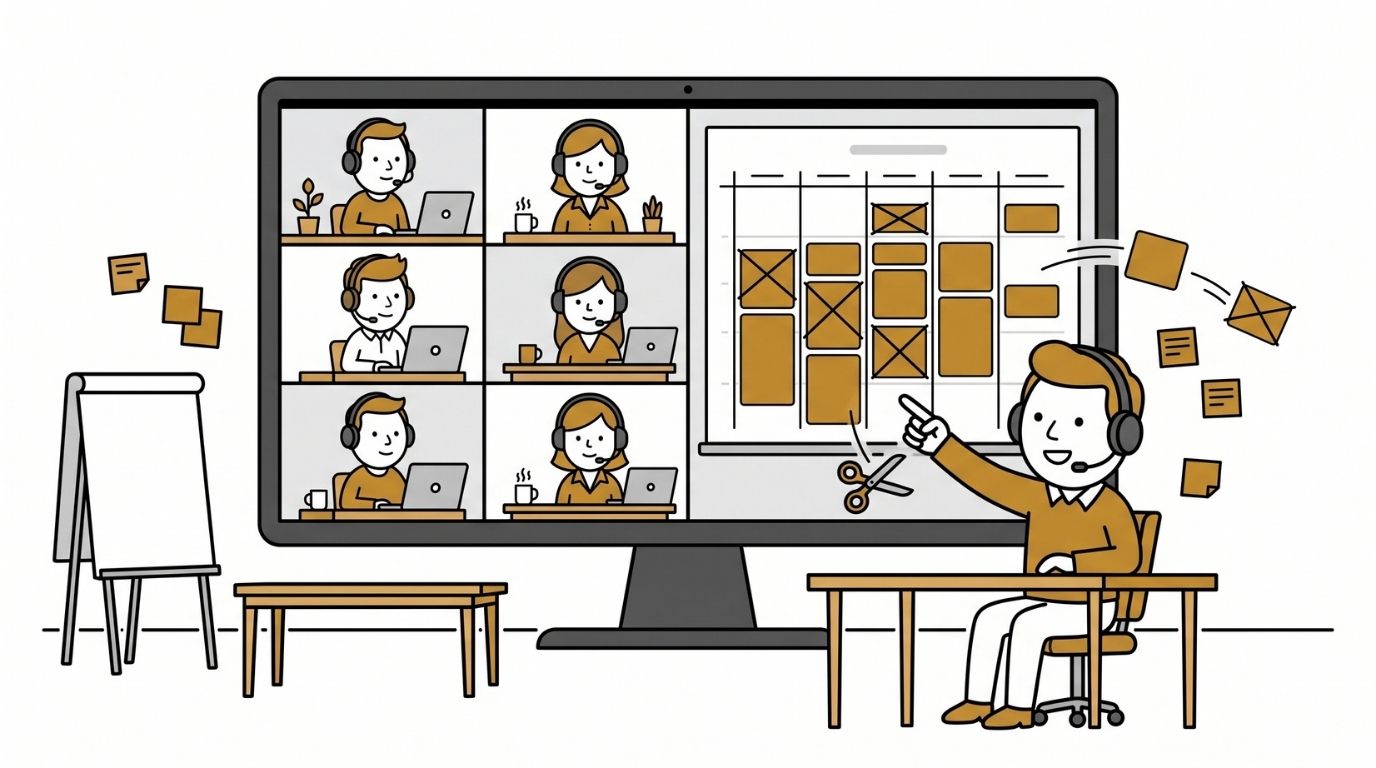
This is a practical workshop where a team audits its whole load of recurring video calls and redesigns it for a remote world. The team lists every recurring meeting it owns, works out what each one costs in people-hours, and places each on a simple life-cycle map to see which meetings still earn their time and which run on habit. It then gives every meeting a verdict of keep, fix, shrink or cut, and redesigns the ones it keeps so each has a clear purpose, outcome and guest list. The session is itself run as a tightly designed call, with its purpose on screen from the start, so the team sees what a better call looks like while it builds one.
Why is it useful?
Distributed teams tend to replace every corridor chat and quick question with a scheduled call, and the calendar fills up one reasonable-looking meeting at a time. Nobody decides to spend half the week on video. It just happens, and it leaves little time for focused work and tires people out. This workshop gives the team a full picture of its meeting load, often for the first time, and a fair way to decide what goes. The team walks away with fewer calls, shorter calls, and calls with a clear job, plus an audit canvas it reruns each quarter and a design page for every meeting it keeps. The gains are easy to measure, because the team can compare its people-hours before and after.
Target Audience
- Consultants, coaches and trainers helping teams with meeting overload
- Team leaders and managers who own a stack of recurring calls
- HR, L&D and People professionals tackling video fatigue and burnout risk
- Any distributed team whose calendar has filled up with calls nobody chose
Workshop Objectives
- See the team's full recurring meeting load and what it costs in people-hours
- Spot which meetings still earn their time and which run on habit
- Give every recurring meeting a verdict of keep, fix, shrink or cut
- Redesign the meetings the team keeps so each has a clear purpose and outcome
- Leave with a lighter meeting load, named owners, and a quarterly re-audit
Summary
Duration: 120 mins
Group Size: 8-16 people
Format: Online or hybrid, highly interactive
Materials Needed
- A video call with breakout rooms
- A shared online whiteboard with the Ecocycle figure-of-eight pre-drawn (see Step 3)
- A shared doc or sheet with the Meeting Audit Canvas, pre-filled from the pre-task
- A way to run a quick poll and a dot vote
- Copies of the Meeting Design Template, one per meeting you expect the team to keep
- A short pre-task, sent two to three days before: "List every recurring meeting this team runs, with how often, how long, and who attends." Everyone adds to one shared list
- For a hybrid room: a screen large enough to show remote faces at a decent size, a second device so the in-room group joins the shared board, and good audio (headsets, or one room mic with the rest muted)
- If you run this fully in person: swap the online board for a wall-sized Ecocycle and sticky notes, and keep the Audit Canvas digital so the numbers live in the team's tools (see Adaptations)
Process
Step 1: Check-in, our week in calls (10 mins)
Goal: Open with a model call and make the size of the meeting load visible.
Activity:
- Put this session's purpose and outcome on screen before anyone speaks: "Purpose: decide which of our recurring calls earn their time. Outcome: a lighter meeting load with owners." Say: "Every meeting we keep today will need a line like this."
- Ask everyone to join on their own device, cameras on. If the meeting is hybrid, use one-person-one-screen and take first voice from the screens.
- Run a quick poll: "How many hours a week do you spend in this team's recurring meetings?" Give bands, for example under 3, 3 to 6, 6 to 10, over 10. Show the spread.
- Run a one-line check-in in the chat: "One recurring call you would miss, and one you would not." Read a sample aloud, screens first.
Debrief Questions:
- What does the spread of hours tell us about who carries the load?
- Is there a call that appeared on both lists, missed by some and not by others?
Step 2: Inventory the meeting load (20 mins)
Goal: Get every recurring meeting onto the Audit Canvas with its true cost in people-hours.
Activity:
- Open the Meeting Audit Canvas, pre-filled from the pre-task. Give 3 minutes for anyone to add a missing meeting. Keep to meetings this team owns, not invites from other teams.
- Explain the sum in one line: people-hours per month equals the number of people, times the length in hours, times the number of times it runs a month. A weekly hour-long call for 10 people is about 43 people-hours a month.
- In breakout rooms of three or four, mixing room and screen, each room takes a share of the meetings and fills in the cadence, the people and the people-hours, 10 minutes.
- Back together, total the column and put the number on screen. Pause and let the team react before you move on.
Debrief Questions:
- What is your reaction to the total?
- Which meeting costs far more than you expected?
- Which meetings have the most people who rarely speak?
Step 3: Ecocycle the meetings (25 mins)
Goal: Place every meeting on a simple life-cycle map to see which still earn their time and which run on habit.
Activity:
- Explain the Ecocycle in 5 minutes, using the figure-of-eight on the board. Everything a team does moves through four stages. Birth is new and still finding its feet. Maturity is working well and earning its time. Creative destruction is ready to end or be rebuilt. Renewal is being reshaped for a fresh start. Two traps sit off the loop. The rigidity trap holds things that have outlived their purpose but keep running on habit. The poverty trap holds needs that never got the time or space to grow, such as a conversation the team needs but never has.
- Solo, 5 minutes. Everyone places each meeting where they think it sits. Use one small dot per person per meeting, so the board shows where people agree and disagree.
- As a group, 10 minutes, look at where the dots cluster. Talk about meetings with scattered dots first. Ask: "Why do some of us see this call as healthy and others as stuck?"
- Name what sits in the rigidity trap, and name anything in the poverty trap, a need that has no meeting behind it. Fill in the Ecocycle column on the canvas.
Debrief Questions:
- Which meeting did we most disagree about, and why?
- What have we kept running only because it was already in the calendar?
- What do we need a conversation about that no meeting covers today?
Place a five-minute comfort break here. Say: "This call is better because it has a break. Take it away from the screen."
Step 4: The purpose test and verdicts (20 mins)
Goal: Give every meeting a clear purpose line and a verdict of keep, fix, shrink or cut.
Activity:
- Explain the purpose test: a meeting earns its place when you can say in one line why people need to be live, and what exists after it that did not before. If nobody can write those lines, the meeting is a candidate to cut.
- In the same breakout rooms, each room writes the purpose line for its meetings and proposes a verdict, 8 minutes. Keep: as it is. Fix: same slot, better design. Shrink: shorter, less often, or fewer people. Cut: stop it, and say what replaces it, if anything.
- Back together, rooms read their verdicts, screens first. Anyone can challenge a verdict.
- For contested verdicts, run a dot vote with three dots each. Record the final verdict on the canvas.
Debrief Questions:
- Which meeting failed the purpose test that we expected to pass?
- Where are we choosing shrink when cut is the honest answer?
- If we cut this meeting, what might we lose, and how do we keep it?
Step 5: Redesign the keepers (22 mins)
Goal: Redesign the biggest meetings the team keeps, so each has a clear job and nothing more.
Activity:
- Pick the two or three kept or fixed meetings with the most people-hours. These are where redesign pays back most.
- Explain Min Specs in a line: find the fewest rules the meeting must follow to do its job, and drop the rest. A meeting with a short, clear shape beats one with a long agenda nobody follows.
- In breakout rooms, one meeting per room, fill in the Meeting Design Template, 12 minutes. Push for the shortest length that works, the smallest group that must attend, and a list of who just gets the notes.
- Each room shares its design in two minutes. The group asks one question per design: "What would we lose if this were ten minutes shorter?"
Debrief Questions:
- Which change will save the most time without losing the point of the meeting?
- Who moved from "must attend" to "gets the notes", and how will they feel about that?
- Where did the design make the meeting better, not just shorter?
Step 6: Commit to the new load (18 mins)
Goal: Lock in the new meeting load, with owners and a plan to tell people.
Activity:
- Read out the cut list and the new total people-hours. Compare it with the number from Step 2.
- For each cut or change, name an owner and who needs telling, including people outside the team who attend. Agree the date the change starts.
- Run 15% solutions, 3 minutes. Each person types one change they can make this week with no permission and no budget, for example declining a meeting where they only need the notes. The 15% is the part inside your own control.
- Name an owner for the Audit Canvas and a date to rerun it next quarter. Close on time, or early, and say so: "We said 120 minutes. We finished in 115."
Debrief Questions:
- What will tell us in a month that this stuck?
- Which cut meeting is most likely to creep back, and what will stop it?
- Who owns the re-audit, and when is it?
Secret Sauce
- Run the session as the model: Put the purpose and outcome on screen at the start, keep to time, and finish early if you can. The team will copy what they see you do far more than what you tell them.
- Check ownership before the session: A meeting run by the most senior person in the room is hard to cut in public. Talk to the leader beforehand, agree that their meetings are open to the same test, and ask them to put one of their own forward as a candidate to cut. Nothing frees up the group faster.
- Use the hours as a hook, not the goal: The people-hours total gets attention, but a short meeting with no purpose still wastes time, and a long one with a clear job may be worth every minute. Keep bringing the conversation back to purpose.
- Watch for the only point of contact: In a remote team, some recurring calls are the only time people see each other. Cutting them can save hours and cost connection. When a social or check-in style call comes up for cutting, ask what replaces the contact, not just the content.
- Stay inside what the team controls: People will want to complain about meetings run by other teams or senior leaders. Park those on a separate list. This session works on the meetings this team owns and can change.
- Protect the screens on every verdict: Take first voice from the screens on each verdict and vote. Remote people often sit through the most meetings with the least voice in them, so their view of what to cut matters most.
- Name who tells whom: A cut meeting that nobody announces quietly carries on. People keep turning up, or someone reschedules it. Every cut needs one person who deletes the series and tells everyone affected.
- Expect grief, and do not rush it: Some people like certain meetings, even tired ones, because they give structure or company. Let people say what they will miss. It makes the cut stick.
- Be honest about the limits: This workshop trims and redesigns the meetings a team owns. It will not fix a culture where leaders expect people on camera all day, or a workload that forces constant coordination. The load also tends to grow back, which is why the quarterly re-audit matters. Say so, so the team does not expect one session to fix its calendar for good.
Adaptations
- In-person or offsite delivery: Teams often gather in person to reset how they work apart, and a meeting audit works well on a wall. Draw a large Ecocycle, put each meeting on a sticky note, and have people place dots by walking up to it, which makes disagreement easy to see. Keep the Audit Canvas digital so the people-hours numbers live in the team's tools afterwards. Keep the remote lesson alive by asking, for each kept meeting, "how does this work for the people who will join on screen?" and plan the format in the design template.
- Larger or smaller groups: Above 16, split the meetings across more breakout rooms and ask rooms to post verdicts on the canvas rather than read them all aloud. Consider running the audit with a smaller group of meeting owners and bringing the verdicts back to the wider team. Below 8, do the inventory and verdicts as one group, and use the extra time to redesign more of the keepers.
- Shorter or longer timeframe: For a 60-minute version, have people fill the Audit Canvas fully in the pre-task, skip the Ecocycle, and run only the purpose test, the verdicts and the commitments. For a half-day, add a round where each person reviews their own calendar against the new design, and add a short follow-up after 30 days to compare the people-hours before and after.
- Different distribution pattern: For a fully remote team, watch hardest for the only-point-of-contact problem, and consider replacing a cut status call with a shorter social one. For a hybrid team with an office core, check whether some meetings only exist because the office group can meet easily, and whether they suit the remote members at all. For a team spread across time zones with little overlap, treat overlap hours as the scarcest resource, and use the audit to protect them for the meetings that truly need people live.