
What is it?
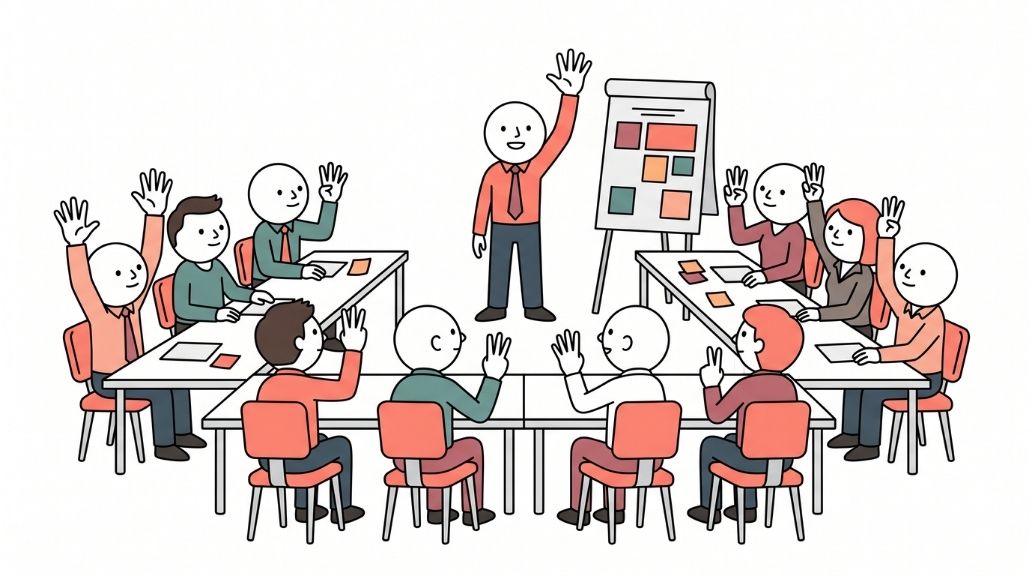
Fist to Five is a quick visual voting method where everyone in the room holds up a hand showing zero to five fingers to signal their level of support for a proposal, idea, or decision. A closed fist means strong opposition. Five fingers means full enthusiasm. Everything in between gives the facilitator an instant, honest read of where the group stands, without anyone having to speak first. It turns the usual murmured "does everyone agree?" into a clear, visible snapshot of the room's actual position.
Also Known As
- Fist of Five
- Five Finger Voting
When to Use It
- You need a quick consensus check during a meeting without opening a full debate
- A proposal has been discussed and you want to gauge whether the group is ready to move forward
- You are facilitating a retrospective and need to prioritise actions
- The group needs to choose between a small number of options (voting on each one in turn)
- You want to surface hidden disagreement that people might not voice in open discussion
- You need to check energy or comfort levels on a topic without calling on individuals
- A decision has been refined through discussion and you want to test whether the refinement worked
- You are working with a group that tends to defer to the loudest voices
When NOT to Use It
- The decision is complex with many interdependent factors that a 0-to-5 scale cannot capture. Use a decision matrix or structured dialogue instead.
- There is a significant power imbalance in the room and people will vote to match the most senior person. Consider anonymous polling or written voting.
- The group has not yet discussed the proposal. Voting before discussion produces noise, not signal.
- You need to choose between many options at once. Dot voting or multi-voting handles this better.
- The topic is deeply personal or emotionally charged, and a public hand vote could put people on the spot. Use private written methods instead.
- You plan to override the vote regardless of the result. Do not ask the question if you will not honour the answer.
Fist to Five emerged from the consensus decision-making tradition and was popularised within the Agile and Scrum communities in the early 2000s. Jean Tabaka is widely credited with bringing the technique to broader awareness through her 2006 book Collaboration Explained: Facilitation Skills for Software Project Leaders. The method draws on older consensus-testing practices used in cooperative governance and community organising, where hand signals were used as a faster alternative to formal voting procedures.
What You Need
Group size: 3 to 30 people. Works best with 5 to 20. Above 30, it becomes difficult for the facilitator to read all the hands at once.
Time required:
- 2 to 5 minutes per vote
- A single round takes under a minute
- Allow extra time if you need discussion rounds with low voters
Space:
- Any room where participants can see each other
- Seating in a circle or U-shape helps the facilitator scan the room
- Virtual rooms work with cameras on (or use a digital polling tool as a substitute)
Materials:
- A clearly stated proposal or question, written where everyone can see it (flip chart, slide, or whiteboard)
- Optional: a printed or projected scale showing what each number means
- Optional: a notepad to record vote distributions if running multiple rounds
The Process
Setup
- Prepare the proposal or question in advance. Write it in clear, simple language that can be answered with a level of agreement rather than a yes or no.
- Decide which voting scale you will use (see Step 1 below) and prepare a visible reference showing what each number means.
- If the group has not used Fist to Five before, plan 2 minutes for a practice round on a low-stakes question.
Step 1: Explain the Scale
Time: 2 to 3 minutes (first time only)
Purpose: Everyone needs to understand what each number means before they vote, or you will get inconsistent signals.
- Display the scale where everyone can see it. The most common version is:
- Fist (0): "I oppose this and cannot support it moving forward."
- 1 finger: "I have serious concerns. I need more discussion before I can support this."
- 2 fingers: "I have reservations, but I can live with it if the group wants to proceed."
- 3 fingers: "I am comfortable. Not my first choice, but I support moving forward."
- 4 fingers: "This is a good decision. I support it."
- 5 fingers: "I am fully behind this. I would champion it."
- Emphasise that the scale is about support, not perfection. "You do not need to love it to vote a four. You just need to feel good about moving forward."
- Clarify the threshold for moving forward. A common approach: "If everyone is at three or above, we will proceed. If anyone is below three, we will hear their concerns first."
- If this is the group's first time, run a practice round. "Let us try this on something easy. On a scale of fist to five, how do you feel about ordering pizza for lunch?"
Watch for:
- People who do not understand the difference between 2 and 3. The distinction matters because 3 is "I support this" and 2 is "I have reservations."
- Confusion about whether the fist is included in the count. Be explicit: fist equals zero.
Step 2: Present the Proposal
Time: 1 to 2 minutes
Purpose: Everyone needs to be voting on the same thing, stated in the same way.
- Read the proposal out loud and point to where it is written.
- Ask: "Is the proposal clear? Does anyone need clarification on what we are voting on?"
- Answer any clarifying questions. If a question turns into a debate, pause and say: "Let us save that for the discussion. For now, I just want to make sure everyone understands what the proposal says."
Watch for:
- Ambiguous wording. If the proposal could be read two ways, tighten it before the vote.
- Scope creep. People may try to amend the proposal at this stage. Note suggested changes but keep the current wording for now.
Step 3: Call the Vote
Time: 30 seconds
Purpose: Simultaneous voting prevents people from copying others.
- Say: "In a moment, I am going to count to three. On three, hold up the number of fingers that shows your level of support. Ready?"
- Count: "One, two, three, vote."
- Scan the room. Look for the overall pattern first, then note any outliers.
- Read the result out loud: "I am seeing mostly fours and fives, with a couple of threes and one two."
Watch for:
- Late voters. Some people wait to see what others show before committing. The countdown helps, but watch for hands that go up slowly or change.
- People who hide their hands or hold them low. Encourage full visibility: "Hold your hand up nice and high so everyone can see."
Step 4: Respond to the Result
Time: 2 to 10 minutes depending on the spread
Purpose: The vote is only useful if you act on the information it gives you.
- If everyone is at the threshold or above (typically 3+): Confirm the decision. "We have consensus. We are moving forward with this proposal." Record it and move on.
- If one or two people are below the threshold: Invite them to share. "I see a one and a two. Would you be willing to share what would need to change for you to move to a three?" Listen without defending the proposal. Ask the rest of the group: "Can we address these concerns?"
- If the group is widely split: Stop and discuss. "We are all over the map on this one. Let us take ten minutes to talk through the key concerns before we vote again."
- After addressing concerns, modify the proposal if needed and run a second vote.
Watch for:
- The temptation to pressure low voters into raising their number. The point is to surface concerns, not to eliminate them through social pressure.
- Discussions that drag on. Set a time limit for the discussion round. "Let us take five minutes to hear the concerns and then vote again."
Closing
Time: 1 minute
- State the final decision clearly. "We voted and reached consensus on [proposal]. This is now our agreed direction."
- Record the outcome and any conditions that were added during discussion.
- If consensus was not reached, record that too, along with the next step: "We did not reach agreement today. We are going to [take it offline / revisit next week / ask Sarah to bring more data]."
Facilitator Guidance
What Makes This Work
Fist to Five works because it replaces a binary yes-or-no vote with a spectrum. This does two things. First, it gives people permission to be somewhere in the middle, which is where most honest opinions actually sit. Second, it makes disagreement visible without making it confrontational. When someone holds up two fingers, they are not blocking or vetoing. They are saying "I have concerns." That is a much easier thing to say with your hand than with your voice, especially in groups where speaking up feels risky. The simultaneous reveal also neutralises anchoring. Everyone commits at the same moment, so the first person to speak does not set the tone for everyone else.
Common Pitfalls
- Skipping the explanation: If you do not define the scale first, people will interpret the numbers differently. One person's "three" is another person's "four." Take two minutes to align the group, especially the first time.
- Allowing sequential voting: If people vote one at a time or raise their hands slowly, they watch each other and conform. Always use a countdown with simultaneous reveal.
- Ignoring low votes: If you call a vote and then move on despite a fist or a one, you have just taught the group that their input does not matter. Always address low votes, even if it slows things down.
- Overusing it: Fist to Five is a quick pulse check, not a substitute for proper discussion. If you use it for every decision in a meeting, people stop taking it seriously.
- Confusing the two scale directions: Two competing standards exist. In one, five fingers means full support. In the other, five fingers means "stop, I oppose this." Pick one and make it explicit. The version described in this guide uses five as full support, which is the more common convention.
- Using it when the decision is already made: If leadership has already decided and you are asking for a vote as a formality, people will see through it. Only use Fist to Five when the group's input will genuinely influence the outcome.
Adaptations
- Virtual/remote: Replace hand signals with a chat-based number (everyone types their number and hits send on the count of three) or use a polling tool. Some video platforms have reaction features, but these are often too slow for simultaneous voting.
- Large groups (30+): Ask table groups to vote internally and report their average or lowest number back to the room. Alternatively, use a digital poll with a 0-to-5 scale.
- Smaller groups (3 to 5): Works well as is. The intimacy of a small group makes the hand vote feel natural and the discussion round fast.
- As a temperature check: Use it mid-discussion rather than at the end. "Before we go further, let me check where everyone is right now. Fist to five on the direction we are heading." This can save time by catching problems early.
- Inverted scale for specific questions: For questions like "How concerned are you about this risk?" flip the scale so that five means high concern. Always state the direction before the vote.
- Anonymous variation: For sensitive topics, have people write their number on a slip of paper and fold it. Collect them and read out the distribution. You lose the speed but gain honesty.
Real-World Applications
Sprint retrospective prioritisation: A Scrum Master uses Fist to Five to check whether the team supports taking on a specific improvement action for the next sprint. Two team members vote a two, surfacing concerns about capacity. The team adjusts the scope and re-votes with consensus at four.
Leadership team strategy alignment: A facilitator presents three strategic options and runs Fist to Five on each one in turn. Option B gets mostly fours and fives. Options A and C are split. The team agrees to pursue Option B and drops the others, saving two hours of debate.
Policy change in a nonprofit board: A board chair uses Fist to Five to test support for a revised conflict of interest policy. The visual vote shows strong agreement except from one board member at a one, who raises a legal concern that leads to a valuable amendment.
Workshop design review: A training team votes on whether a proposed agenda is ready to pilot. The vote shows mostly threes, suggesting the design is acceptable but not strong. The facilitator digs into what would make it a four, leading to two practical changes that improve the session.
Community planning meeting: A neighbourhood group uses Fist to Five to test support for a proposed park redesign. The visible vote surfaces a pocket of concern from residents near the boundary, prompting a breakout discussion that resolves a noise concern and builds broader buy-in.