
What is it?
Perspective-Taking Exercises are structured activities that ask participants to step out of their own viewpoint and consider a situation, decision, or problem through someone else's eyes. The group works through a series of guided exercises where they adopt the mindset of a specific stakeholder, colleague, customer, or affected party, then articulate what that person might think, feel, need, or worry about. The result is a richer, more complete picture of a situation that no single viewpoint could produce on its own. Participants often report that the exercise shifts something in how they see a conflict or decision, not because they changed their mind, but because they now understand what they were missing.
Also Known As
- Role Reversal
- Walk in Their Shoes
When to Use It
- Two or more groups are stuck in a disagreement and each side believes the other "just doesn't get it"
- A team is making a decision that affects people who are not in the room (customers, frontline staff, partner organisations, communities)
- Cross-functional teams are blaming each other for slow progress or poor handoffs
- Leaders need to understand the lived experience of people several layers below them in the organisation
- A project team is designing a product, service, or process and wants to stress-test it from multiple user perspectives
- Merger or restructuring work where different cultures or working styles are colliding
- Post-incident reviews where understanding different actors' reasoning matters more than assigning fault
- Diversity, equity, and inclusion conversations where genuine understanding (not performative agreement) is the goal
When NOT to Use It
- The conflict involves active harm, bullying, or abuse. Asking someone to "see the other side" when they have been mistreated can feel dismissive and re-traumatising. Address safety first.
- Participants are not willing to engage in good faith. If people treat the exercise as an opportunity to mock or caricature the other perspective, it does more damage than skipping it entirely.
- The issue has already been decided and there is no room for the insights to change anything. People resent being asked to empathise if the outcome is fixed.
- Power dynamics are so extreme that one group cannot speak candidly about another without fear of retaliation. The exercise requires psychological safety to work.
- You need a quick energiser or warm-up. Perspective-taking requires genuine cognitive and emotional effort. Dropping it in as a five-minute filler cheapens it.
- The group has no real connection to the stakeholders they would be asked to represent. Guessing at the experience of people you have never met or spoken with can reinforce stereotypes rather than build understanding.
Perspective-Taking Exercises draw on multiple traditions rather than a single inventor. The concept of role reversal in group settings traces back to Jacob L. Moreno's psychodrama work in the 1940s, where participants would physically swap roles to experience a situation from another person's position. The social psychology research of Adam Galinsky and colleagues from the early 2000s onward provided the empirical backbone, demonstrating that cognitive perspective-taking (as distinct from emotional empathy) improves negotiation outcomes, reduces stereotyping, and strengthens coordination. In facilitation practice, these exercises have been shaped by contributions from conflict resolution, design thinking (empathy mapping and user perspective work), and organisational development. No single originator can claim the method; it has evolved through decades of practice across therapeutic, educational, and organisational settings.
What You Need
Group size: 6 to 30 participants. Works best with 8 to 20. Below 6 you lack enough diversity of thought. Above 30 you need multiple facilitators and the debrief becomes unwieldy.
Time required:
- 45 minutes minimum for a single focused exercise
- 60 to 90 minutes is typical for a full sequence with setup, exercise, and debrief
- Extended versions with multiple perspectives can run 2 to 3 hours
Space:
- Room with movable chairs (not fixed lecture seating)
- Wall space or tables for posting written perspectives
- Enough room for pairs or small groups to talk without shouting over each other
- A separate area or breakout space if running a fishbowl variation
Materials:
- Flip chart paper and markers (one set per small group)
- A4 paper or index cards for individual reflection
- Pre-prepared perspective cards or stakeholder profiles (if using the structured version)
- Sticky notes in two or three colours
- Timer visible to the room
- Printed scenario brief or decision summary (one per participant)
The Process
Setup
- Choose the situation, decision, or conflict that will be the focus. Write a clear, neutral one-paragraph summary that all participants will work from. Avoid language that favours one perspective.
- Identify 3 to 5 distinct perspectives that matter for this situation. These might be specific roles (customer, frontline worker, senior leader, regulator), specific teams (engineering, sales, operations), or specific stakeholder groups (community members, investors, end users).
- Prepare a Perspective Card for each viewpoint. Each card should include: the role or stakeholder name, 3 to 4 bullet points describing their typical priorities, pressures, and constraints, and 1 to 2 key questions they would be asking about this situation.
- Decide which exercise format to use (see Adaptations for options). The core process below uses the Role Reversal format, which is the most versatile.
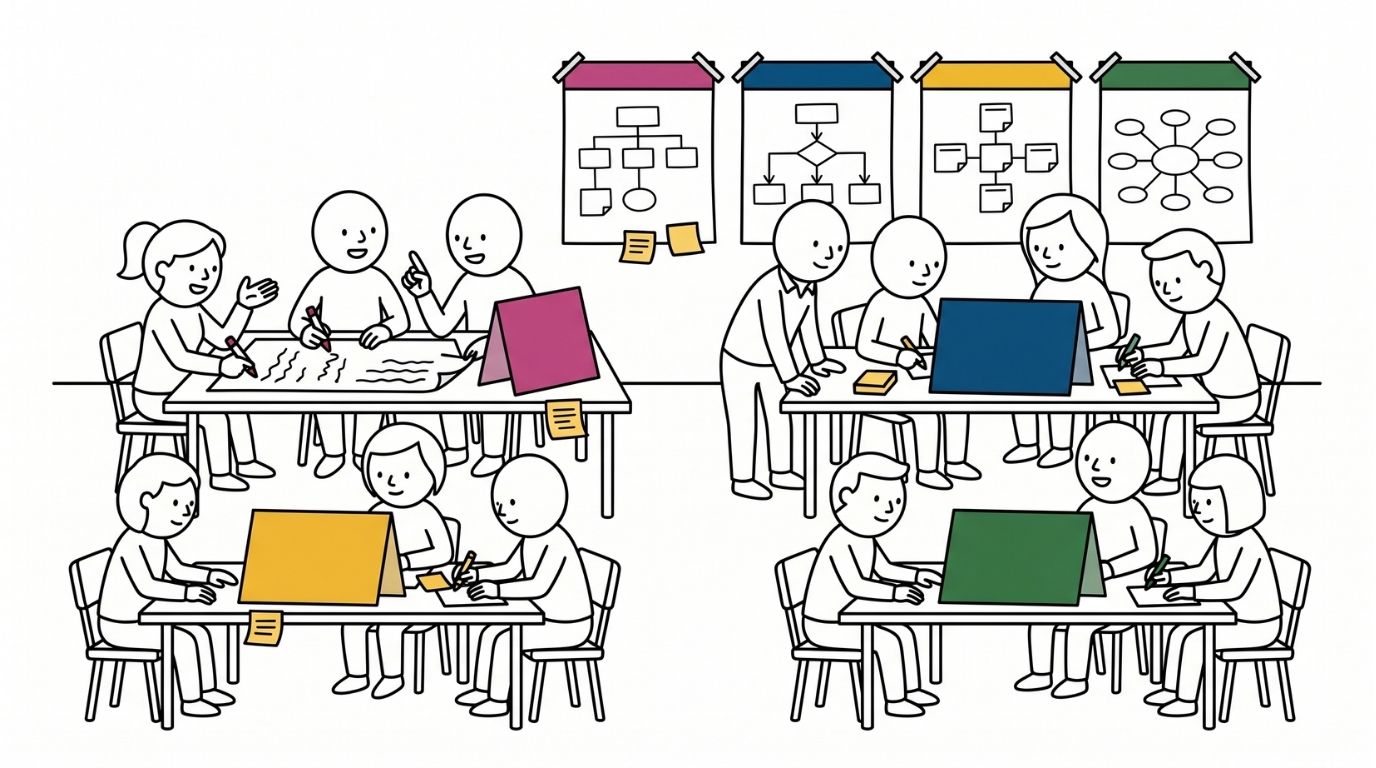
- Arrange chairs in small groups of 3 to 5. Each group will take on one perspective.
- Post the situation summary on a flip chart visible to everyone.
Step 1: Frame the Exercise
Time: 5 to 10 minutes
Purpose: Set the tone and make the rules of engagement clear so people commit to genuine exploration rather than surface-level performance.
- Explain what the group will be doing: "We are going to spend the next hour looking at [this situation] through the eyes of people who see it differently from us. The goal is not to agree with every perspective. The goal is to understand each one well enough that the person you are representing would say, 'Yes, that is what it feels like from where I sit.'"
- Acknowledge that this can feel uncomfortable: "Some of you may find it awkward to argue for a position you disagree with. That discomfort is a signal you are doing it right. Lean into it."
- Set one ground rule: "When you are in your assigned perspective, stay in it. Do not break character to say 'Well, I personally think...' Save your own views for the debrief."
- Distribute the situation summary and give the group 2 minutes to read it silently.
Step 2: Assign and Inhabit Perspectives
Time: 15 to 20 minutes
Purpose: Give participants enough time to genuinely get into a different mindset rather than rushing to surface-level assumptions.
- Assign one perspective to each small group. Where possible, assign people to a perspective that is not their own. A finance person takes the customer perspective. A senior leader takes the frontline worker perspective. This deliberate mismatch is where the learning happens.
- Hand out the Perspective Card for each group's assigned viewpoint.
- Ask each group to spend 5 minutes reading and discussing their Perspective Card together. Prompt them: "Before you react to the situation, make sure you understand who you are. What keeps this person up at night? What does success look like for them? What constraints do they work within that others might not see?"
- Then give 10 to 15 minutes for each group to work through the situation from their assigned perspective. Ask them to capture on flip chart paper:
- "What do we see when we look at this situation?"
- "What concerns us most?"
- "What do we need from the other parties?"
- "What would a good outcome look like for us?"
- Circulate between groups. Listen for depth. If a group is producing shallow or stereotypical responses ("They just care about money"), push them: "If that person were sitting here, would they feel you understood them? What are you missing?"
Watch for:
- Groups rushing through the Perspective Card without discussion. Slow them down. The card is a starting point, not a checklist.
- Participants breaking character to insert their own opinions. Gently redirect: "Stay in your role for now. There will be time for your own view later."
Step 3: Share Perspectives
Time: 15 to 20 minutes
Purpose: Let each group present their perspective to the whole room so everyone hears the full range of viewpoints.
- Bring the full group back together. Each small group presents their perspective in 3 to 4 minutes. They should speak as if they are the stakeholder: "We are the frontline team, and here is what this situation looks like from where we stand..."
- After each presentation, allow 1 to 2 minutes for clarifying questions only. No rebuttals, no corrections, no "but actually." The rule is: "You can ask questions to understand. You cannot argue."
- Once all perspectives have been shared, pause. Let the room sit with what they have heard for 30 seconds of silence before moving to the debrief.
Watch for:
- Other groups interrupting to correct or challenge. Hold the line on "questions to understand only." This is the hardest boundary to maintain and the most important one.
- Presentations that drift into parody or exaggeration. If a group is playing their perspective for laughs rather than insight, step in: "Let us take this seriously. What would this person actually say?"
Step 4: Debrief and Harvest
Time: 15 to 20 minutes
Purpose: This is where the real learning happens. The debrief converts the experience into insight and, where relevant, into action.
- Start with a moment of individual reflection. Give each person 2 minutes to write down their answer to: "What surprised you? What did you learn about this situation that you did not see before?"
- Open the group discussion with these questions:
- "Which perspective was hardest to inhabit? Why?"
- "What did you hear from another group that changed how you see this situation?"
- "Where are the genuine tensions between these perspectives? Which of those tensions cannot be resolved and need to be managed?"
- "What would each stakeholder need in order to feel heard and respected, even if they do not get everything they want?"
- If the exercise is connected to a real decision or ongoing situation, move to action: "Based on what we have learned, what should we do differently? What conversations do we need to have? Who needs to be in the room who is not here?"
- Capture key insights, unresolved tensions, and action items on a flip chart. Assign owners and timelines for any actions.
Closing
Time: 5 minutes
- Ask each participant to share one sentence: "What is one thing you will do differently as a result of this exercise?"
- Thank the group for their willingness to step outside their own viewpoint. Acknowledge that it takes courage.
- If relevant, confirm when and how the insights will be used and who will follow up on action items.
Facilitator Guidance
What Makes This Work
Perspective-taking works because it engages a different cognitive process from debate or discussion. When people argue their own position, they recruit evidence that supports their existing view. When they are asked to argue someone else's position, they have to build a mental model of that person's world. Research by Adam Galinsky and colleagues has shown that this cognitive shift (distinct from emotional empathy) improves the ability to find hidden agreements, reduces stereotyping, and increases creative problem-solving. The exercise works best when participants are assigned to a perspective that is genuinely unfamiliar to them, when they have enough context to engage with it seriously, and when the debrief gives them space to process what shifted in their thinking.
Common Pitfalls
- Assigning people to their own perspective: The whole point is the stretch. If the finance team takes the finance perspective, they learn nothing new. Deliberately cross-assign, even if people resist.
- Skipping the Perspective Cards: Without structured context, participants default to stereotypes and assumptions about the other viewpoint. The cards give them a foothold for genuine exploration.
- Allowing debate during the sharing round: The moment you let one group challenge another's presentation, the exercise collapses into a regular argument. Protect the "questions to understand only" rule as if your session depends on it, because it does.
- Rushing the debrief: The exercise without the debrief is just an interesting activity. The debrief is where participants connect the experience to their real work and relationships. Give it at least as much time as the exercise itself.
- Using it when trust is too low: If people cannot be vulnerable enough to genuinely try on another viewpoint, the exercise will feel forced and performative. Build psychological safety before attempting perspective-taking work.
- Picking perspectives that are too abstract: "The customer" is less useful than "a first-time buyer who has just had a delivery go wrong." Specificity makes the perspective real enough to inhabit.
Adaptations
- Virtual/remote delivery: Use breakout rooms for the small group work. Have each group capture their perspective in a shared document rather than on flip chart paper. Presentations happen in the main room. The debrief works well with a round-robin format where each person shares one insight. Allow extra time (add 10 to 15 minutes) since transitions are slower online.
- Fishbowl variation: Instead of small groups presenting, seat one representative from each perspective group in an inner circle. They have a conversation about the situation while staying in character. The outer circle observes. This variation is more dynamic and generates richer dialogue, but requires more facilitator skill to manage.
- Pair-based "Walk in Their Shoes": For smaller groups or less complex situations, pair people up and have them interview each other as if they were the stakeholder. Partner A asks questions; Partner B answers in character. Then swap roles and perspectives. This is faster (20 to 30 minutes total) and more intimate.
- Written perspective letters: Each participant writes a one-page letter from the stakeholder's point of view, addressed to the decision-makers. Letters are posted anonymously on a wall and the group reads them in a gallery walk format. This works well when the topic is sensitive and people need the safety of anonymity.
- Larger groups (20 to 30): Run the same process but with more perspective groups. Keep each group to 4 to 5 people maximum. During the sharing round, have groups post their flip charts and do a gallery walk rather than full presentations, to save time.
- Shorter timeframe (30 minutes): Use the pair-based version with pre-prepared scenario cards and a focused 10-minute debrief. You lose depth but still get value.
- Recurring use: Run perspective-taking exercises at regular intervals during a long project or change programme. Each session focuses on a different stakeholder or a different phase of the situation. The cumulative effect is stronger than a single session.
Real-World Applications
Cross-functional product team resolving a launch delay: A software company used perspective-taking exercises during a retrospective after a missed release date. Engineers took the sales team's perspective, sales took the customer's perspective, and product managers took the engineering perspective. The exercise revealed that each group had been making rational decisions within their own constraints, but nobody had visibility into the trade-offs others were making. The team created a shared dependencies board as a direct result.
Hospital leadership understanding frontline experience: A hospital trust ran a "Walk in Their Shoes" session where senior administrators took on the perspective of ward nurses during a staffing shortage. The exercise surfaced specific pain points (reporting systems that added 45 minutes to each shift, supply ordering processes that required three approvals) that leadership had not been aware of. Two of the five action items from the session were implemented within a month.
Merger integration between two company cultures: During a post-acquisition integration, teams from both organisations participated in perspective-taking exercises where each side articulated what the merger looked like from the other company's point of view. The exercise moved the conversation from "they are resistant to change" and "they are steamrolling our culture" to specific, addressable concerns about reporting lines, decision-making authority, and brand identity.
Local government planning consultation: A council planning team used perspective-taking exercises to prepare for a community consultation about a new housing development. Staff took on the perspectives of long-term residents, new buyers, local business owners, and environmental campaigners. The preparation helped them anticipate concerns and design a consultation process that addressed each group's priorities rather than treating "the community" as a single voice.
Sales team improving client relationships: A B2B sales team used a simplified version where each salesperson wrote a "letter from the client" describing what it was like to be on the receiving end of their sales process. The exercise revealed that what the team experienced as "thorough follow-up" felt to clients like "relentless pressure." The team restructured their outreach cadence based on the insights.