
What is it?
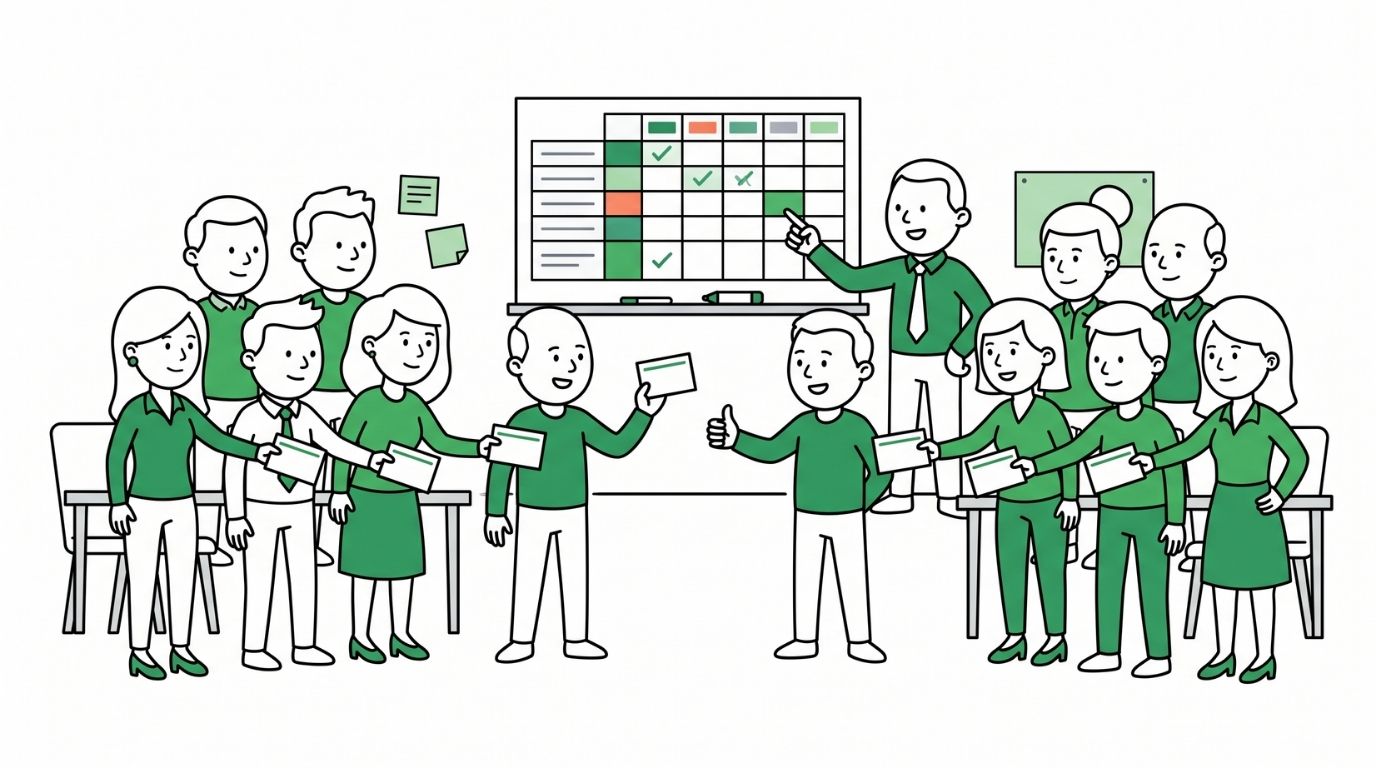
A Roles and Expectations Clarity workshop gets a team to spell out who does what, who decides what, and what each person needs from the others. Over two hours the group maps the main areas of work, agrees where decision rights sit, and makes clear requests of each other so expectations stop living in people's heads. They leave with an agreed picture of ownership and decisions, and far fewer of the grey areas that cause friction later.
Why is it useful?
When roles are fuzzy, teams pay for it in slow decisions, dropped work and quiet resentment. Two people think they own the same thing, or each assumes the other does, and it falls through the gap. This workshop drags those assumptions into the open while the whole team is present. People find out what others actually expect of them, decisions get a clear owner, and the team stops relitigating who should have done what. The payoff is faster decisions and fewer awkward "I thought you had that" moments.
Target Audience
- Team leaders and managers setting up clear ownership in a new or reshaped team
- Consultants and coaches untangling role overlap and decision bottlenecks
- HR, L&D and people partners supporting restructures or team mergers
- Cross-functional or project teams where responsibilities blur across roles
Workshop Objectives
- Map the main areas of work and name a clear owner for each
- Agree where decision rights sit for the decisions that matter
- Surface and settle mismatched expectations between roles
- Make clear requests of each other and get clear answers
- Leave with an agreed record of roles, decisions and commitments
Summary
Duration: 120 mins
Group Size: 8-16 people
Format: In-person, highly interactive
Materials Needed
- Printed Decision Rights Map sheets, plus one large copy for the wall
- Flip charts and marker pens
- Sticky notes and sticky dots
- Index cards for written requests
- Blu-tack or masking tape
- A visible timer
- A laptop to type up the agreed map
Process
Step 1: Check-in and Frame (10 mins)
Goal: Ground the group and name the cost of fuzzy roles.
Activity:
- Quick round: name, role in one line, and one thing they wish were clearer about who does what.
- Explain the aim: "By the end we'll know who owns what, who decides what, and what we each need from each other."
- Give a quick example of the cost of grey areas, such as a decision that stalled because no one was sure they could make it.
- Set the tone: "This is about clarity, not blame. We're sorting the gaps, not scoring points."
Debrief Questions:
- Where do you feel the biggest grey area on this team right now?
- What does it cost us when ownership is unclear?
Step 2: Map the Work (20 mins)
Goal: List the main areas of work and give each a clear owner.
Activity:
- As a group, list the big chunks of work the team owns on a flip chart. Aim for the main areas, six to ten, not every task.
- For each area, ask "Who leads this?" and write one name against it. Add a support name if needed.
- Mark any area with no owner, and any where two or more people think they lead.
- Handle the clashes out loud. For each contested area, let the people involved say what they believe they own, then agree a single lead.
- Note any area still without an owner as an open item to resolve.
Watch for: The list ballooning into a task list. Keep pulling it back up to areas, not activities.
Debrief Questions:
- Which area was hardest to name a single owner for, and why?
- Are there gaps here that no one is currently holding?
Step 3: Who Decides What (25 mins)
Goal: Agree where decision rights sit for the decisions that matter.
Activity:
- Ask the group to name the decisions that most often get stuck or bounce around. Capture six to eight on sticky notes.
- Introduce three simple roles for each decision: who decides, who must be consulted first, and who just needs to be informed after.
- Take each decision in turn and fill it in on the Decision Rights Map: one decider, the people to consult, the people to inform.
- Push for a single decider per decision. Where the group wants to share it, ask "Who has the final say if you don't agree?"
- Read the map back and check it holds.
Watch for: Decisions with three deciders. That is usually the source of the bottleneck, so keep pressing for one.
Debrief Questions:
- Which decision will speed up most now it has a clear owner?
- Where did we assume someone was consulted when they were not?
Step 4: What I Need From You (30 mins)
Goal: Make clear requests across roles and get clear answers.
Activity:
- Group people by role or closely related roles. If roles are mostly individual, pair people up by who works together most.
- Give each group index cards. Ask them to finish this line for each other group: "What we need from you to do our job well is..." One clear request per card. Keep it to their top two or three per group.
- Bring the group back together. One group at a time reads a request aloud to the group it is aimed at.
- The receiving group answers with one of three clear responses only: "Yes", "No", or "Let's negotiate". No long justifications. A short clarifying question is fine.
- Capture every "Yes" as a commitment and every "Let's negotiate" as a follow-up with a named owner. Work round until the main requests are heard.
Watch for: People softening a "No" into a vague "maybe". A clear no is more useful than a false yes, so hold them to a straight answer.
Debrief Questions:
- Which request were you surprised had never been said out loud?
- What was harder, making a clear request or giving a clear answer?
Step 5: Close the Gaps (15 mins)
Goal: Capture what was agreed and deal with the biggest remaining mismatch.
Activity:
- Pull together the open items: unowned areas from Step 2, shared decisions from Step 3, and "Let's negotiate" cards from Step 4.
- Pick the one that would cause the most trouble if left unresolved.
- Work it in the room. Agree an owner and a next step, even if the full answer needs more time.
- Assign an owner and a date to each remaining open item so none of them drift.
Debrief Questions:
- Which open item worries you most if we leave it unresolved?
- Who needs to be involved to close the ones we could not finish today?
Step 6: Commit and Close (20 mins)
Goal: Confirm the agreements, commit, and close well.
Activity:
- Recap the agreed picture: owners for each area, the decision rights map, and the requests people said yes to.
- Ask each person to name one expectation they will now meet differently because of today.
- Ask people to initial the Decision Rights Map as a sign they accept it.
- Agree who types up the map and open items, where they will live, and a date to review them.
- Close with a quick round: one word on how much clearer things feel.
Debrief Questions:
- What is the first thing you will do differently now expectations are clear?
- What will tell us in a month that this clarity has stuck?
Secret Sauce
- Areas, not tasks: Teams drift into listing every job. Keep the map at the level of areas, or you will run out of wall and time.
- Insist on one decider: The whole point of the decisions step is to remove bottlenecks. Shared decision rights usually recreate them, so push for a single final say.
- Hold the three answers: The requests round only works if people give a clear yes, no or negotiate. A false yes to keep the peace stores up the exact problem you are trying to fix.
- Keep it blame-free: Frame every gap as something to sort, not someone to blame. The moment it feels like fault-finding, people go quiet.
- Name the silent overlap: Two people believing they own the same area is common and rarely said. Draw it out gently in the room.
- Owners on open items: Anything unresolved needs a name and a date, or it quietly vanishes and resurfaces as friction.
- Book the review: Roles shift as work changes. A review date keeps the map honest.
Adaptations
- Virtual or remote delivery: Build the Decision Rights Map as an online whiteboard grid. Use breakout rooms for the role groups drafting their requests, then read them out in the main room and capture each yes or negotiate live. Replace initials with each person typing their name. Remote teams lean harder on decision clarity, so give Step 3 a little extra room.
- Larger or smaller groups: Above 16, form more role groups and cap each at its top two requests, or Step 4 overruns. Below 8, run the work map as a single group and give more airtime to the requests round, since individual expectations matter more in a small team.
- Shorter or longer timeframe: For a 60-minute version, pre-list the areas and the sticky decisions so the room time goes on decision rights and requests. With a half day, add a stakeholder map of the people outside the team they depend on, and clarify expectations with them too.
- Different context or purpose: For a merged team, run the requests round between the two legacy groups so old assumptions surface. For a project team, map decision rights against project stages rather than standing areas. For a matrixed team, make the split between line manager and project lead explicit on the map.