
You give advice. You share a similar experience. You offer a suggestion, a fix.
You do it quickly, because when you hear about a problem not responding to it feels uncomfortable.
This is what most people do. It is also, most of the time, the least useful thing you can do.
The person walks away with your solution to their problem. Not their own.
And your solution, no matter how good it is, has a shelf life before it stops fitting their situation.
Two new techniques in the library this week.
One gives you a structured way to practise four completely different responses to someone asking for help.
The other gives you a method for getting past surface-level answers when a group keeps fixing symptoms instead of causes.
NEW: 2 Facilitation Techniques
You're reading the free version of this newsletter. Each week, Pro members get full access to every technique guide in the library — 313 and counting — plus the AI workshop adaptor that customises any guide for your exact group size, timing, and audience. The 3 hours you spend designing a session from a blank page? Pro members spend 20 minutes adapting a tested guide.
→ Start your Pro membership
Helping Heuristics
(free download until Tuesday)
Most people have one mode when someone asks for help. They give advice.
Coaches ask questions. Quiet types listen. Direct types tell you what they think.
None of these are wrong. But using only one limits what becomes possible.
And most people have never practised switching between them deliberately.
Helping Heuristics fixes this.
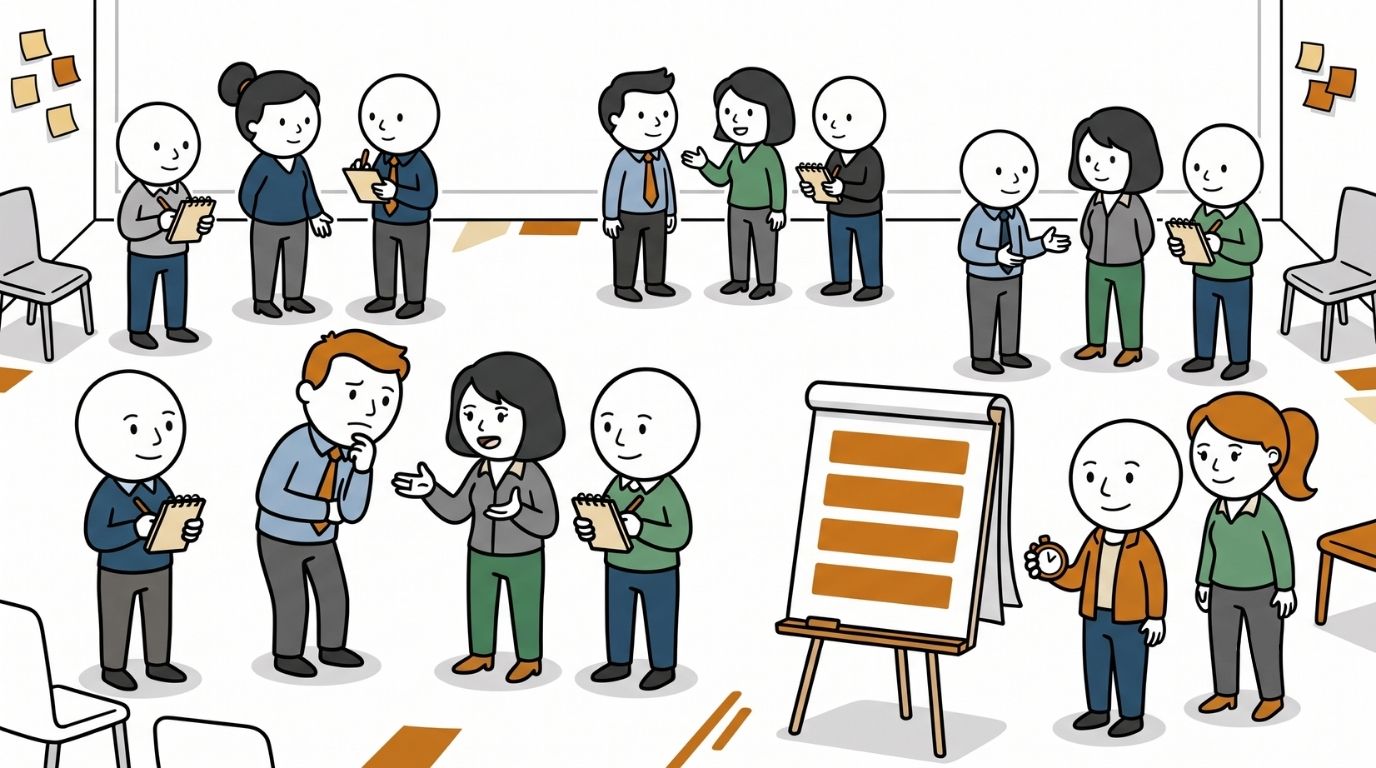
Groups of three rotate through four rounds, each lasting two minutes. One person is the client (sharing a real challenge), one is the coach (responding using the pattern for that round), and one is the observer (watching the dynamics closely).
The client shares the same challenge in every round. The coach changes their approach. Here is what each round looks like:
Round 1: Quiet Presence
The coach listens. The only permitted response is "What else?" No advice, no questions, no suggestions. Just full attention and two words. This round is the one people find hardest, and is almost always the one clients say helped them think most clearly.
Round 2: Guided Discovery
The coach asks open questions aimed at drawing out the client's own experience. "Tell me about a time you faced something similar and found a way through." The questions point the client toward their own knowledge, not toward the coach's.
Round 3: Loving Provocation
The coach gets direct. If they see something the client is avoiding, they name it. If they have a recommendation, they offer it. This round gives permission to say the thing most people are too polite to say. It comes from care, not confrontation.
Round 4: Process Mindfulness
Both coach and client drop into open conversation. No rules about who speaks. Both build on whatever emerges. The observer watches how the dynamic shifts when both people are fully engaged.
After all four rounds, the observer shares what they noticed. Then the client. Then the coach.
The observer's perspective is where most of the learning is, because they catch patterns that neither the client nor the coach can see while they are in the middle of it.
The whole exercise takes 25 minutes for one cycle. Run two cycles so more people experience the client role.
You need groups of three, a visible display of the four patterns, and a timer. No flip charts, no sticky notes, no special room setup.
The moment to watch for: Coaches slipping into advice during Round 1. It happens in almost every group. Someone shares a problem and the coach's hand twitches toward a suggestion. If you hear it happening across the room, give a gentle reminder: "Round 1 coaches, your only words are 'What else?'"
Where this lands: It works as a standalone exercise in any leadership development programme, team kickoff, or consulting skills workshop where you want people to expand their range beyond advice-giving.
Read the full Helping Heuristics guide →
5 Whys / Nine Whys (Pro Members)
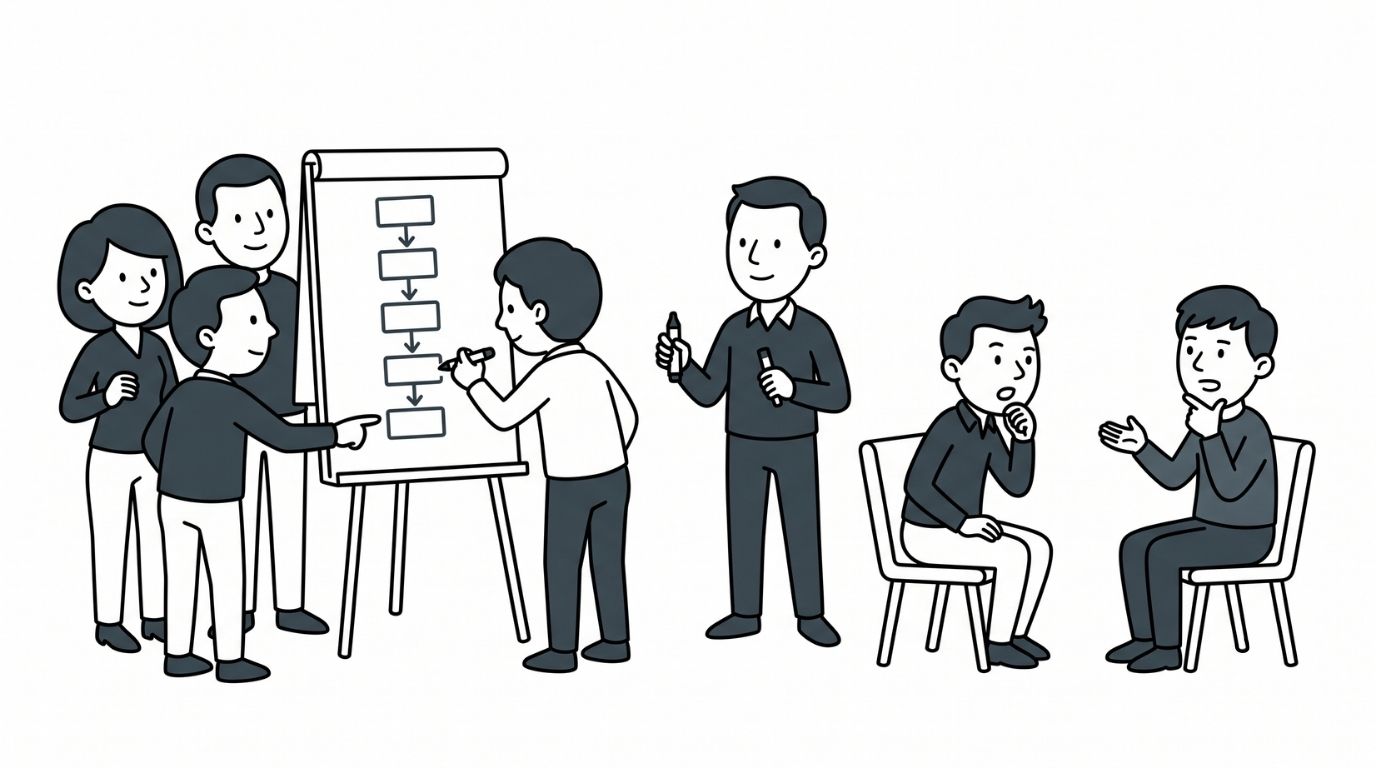
The problem it solves: The same problem keeps coming back. Every retrospective produces actions, and three months later you are having the same conversation again. The issue is that the group keeps addressing symptoms because no one has traced the problem back far enough to find the root.
This guide covers two techniques in one. The classic 5 Whys (root cause analysis, developed at Toyota in the 1930s) and Nine Whys (a Liberating Structure for purpose clarification).
Most people only know the Toyota version. The guide covers both, including when to use which, how to stop groups from turning "why" into blame, and what to do when the chain branches into multiple causes at the same level.
Read the full guide with a Pro membership →
What's in the WorkshopBank library?
313 detailed techniques in the library (at time of publication) and a search that finds the right technique for your next session in seconds.
Every guide follows the same standard: when to use it, when not to, the full process with timings, facilitator notes on what goes wrong and how to recover, and adaptations for virtual, large group, and short-timeframe versions.
Questions? Send me a message using the Contact Us link in the footer. I reply personally.