
Working from home was supposed to give you more time
Four quick questions to find where your week goes, and four new workshops to get it back.
Imagine it's Thursday evening and you're on your sofa, answering messages about a decision your team made this afternoon.
It took five minutes in the end. But it came up on Monday, and you put it on the agenda for Thursday's team call, because that was the only time everyone could make.
Your two colleagues in Singapore joined at 11pm their time.
So the decision waited three days.
You work from home three days a week, as do others on your team. It is supposed to give you more time, not less.
For a lot of distributed teams, it does the opposite.
When everyone is together in an office, a few things keep the working week in check.
There are only so many meeting rooms, so there are only so many meetings.
When a decision is needed, you can get the right people together in five minutes.
Everyone starts and finishes at roughly the same time. And when you leave the building, the working day is over.
Working remotely takes all of that away. Unless your team agrees new habits to replace them, the week fills up.
This week's four new team workshops
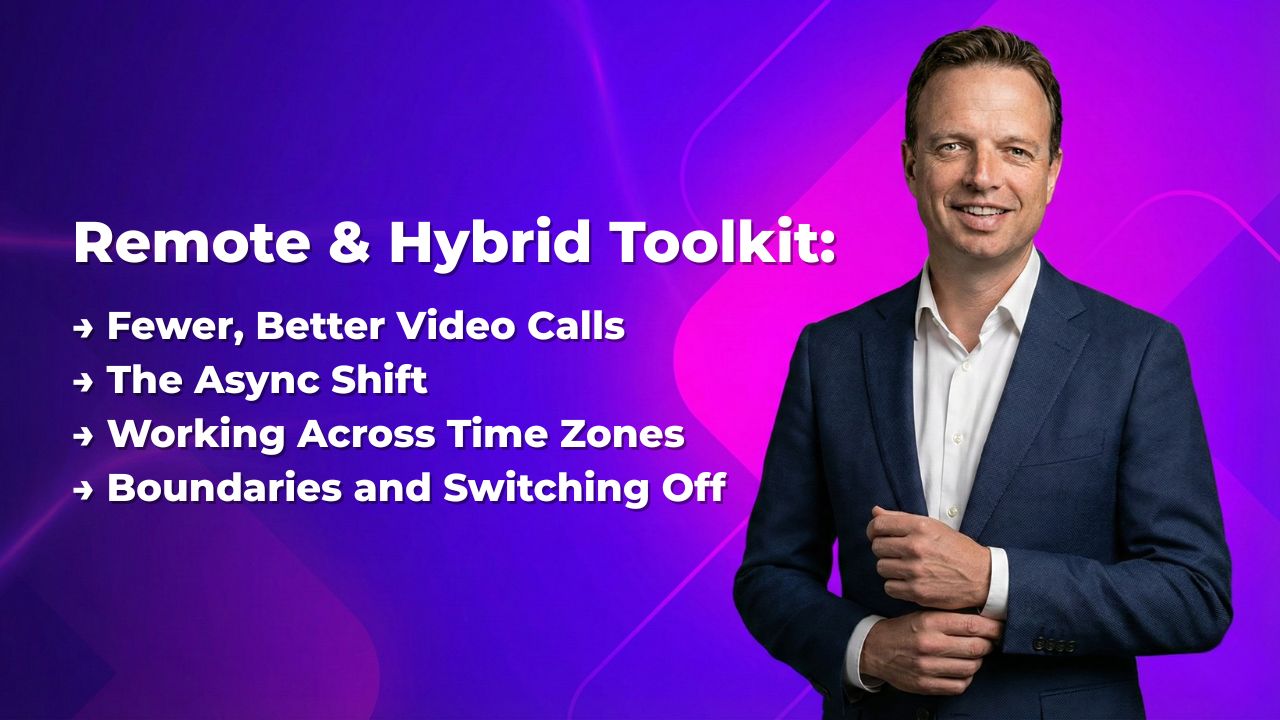
They're the next release in the Remote and Hybrid Team Toolkit, a set of ten workshops for teams that work apart.
Each one deals with something the office used to do for you:
→ Fewer, Better Video Calls for better meetings
→ The Async Shift for quicker decisions
→ Working Across Time Zones for reducing waiting
→ Boundaries and Switching Off for improving work/life balance
Each is a ready-to-run, two-hour session with a full facilitator guide.
They all run over video or in a hybrid room, so your team practises the new habits in the session itself.
And each ends with something your team keeps using: a lighter calendar, a way to decide in writing, a handover note, or a team agreement.
To see which one your team needs first, answer four questions (they take a minute each).
Jot down your answers, because we'll come back to them.
1. How many hours does your team spend in recurring meetings?
List every recurring meeting your team runs. For each, multiply the number of people by the length in hours, then by how many times it happens a month. Add them up.
For example, a weekly one-hour call with ten people comes to about 43 hours of people's time a month. Five meetings like that add up to more than one person's entire working month.
Fewer, Better Video Calls takes that list apart. Your team looks at every recurring meeting, decides whether to keep, fix, shorten or cut it, and redesigns the ones it keeps.
You come out with a lighter calendar and a date to check it again next quarter.
2. How many decisions are waiting for a meeting?
Count the decisions your team is holding onto until the next call.
Most would take five minutes if the right people were together. Each one holds up work that depends on it.
The Async Shift shows your team how to make those decisions in writing.
You learn a one-page proposal format that replaces the call, then make a real decision in writing during the session itself.
You come out with a decision log and one or two regular meetings you'll replace with written updates for a month.
3. How long does work wait between time zones?
If your team spans time zones, think of the last piece of work that got stuck waiting for someone in another one.
How many hours passed between the question and the answer?
For example, you send a question from London at 5pm and it reaches Singapore at midnight. They pick it up the next morning. If one detail is missing, their follow-up arrives in London overnight, and what should have been a five-minute answer takes two days.
Working Across Time Zones helps your team find out how much working time it really shares, which is often less than people think, and trace where handed-over work gets stuck.
You design a handover note the next person can act on without having to ask anything, and agree a fair way to share the late calls.
4. How many evenings were you still working?
Count the evenings last week you read or answered work messages after you'd finished for the day.
If it's most of them, you're probably not alone. People reply at 9pm because nobody wants to be the one who looks offline.
Boundaries and Switching Off gets your team to agree what "off" means, when it's fair to message someone out of hours, and what happens when you get busy.
The team leader commits first. You come out with a one-page agreement and protected focus time already in everyone's calendar.
Now look at your four answers
None of them improves on its own. Meetings creep back into the calendar, decisions pile up, work sits overnight, and evenings stay busy.
What fixing one of them is worth
WorkshopBank Pro costs $192 a year.
It's my workshop library that more than 200,000 facilitators and leaders have trusted over the last 15 years.
It includes all four of these team workshops and 351 others (with more added every week).
Cut one weekly hour-long call with ten people and you get back about ten hours a week. Even at $20 an hour, one week covers a year's membership.
Why join today
The price goes up as the library grows, and it never comes down. Last week there were 351 workshops. Today there are 355. Next Saturday there'll be 358.
Join now and you keep today's price, and get every new workshop as it's added.
Have a fabulous weekend,
P.S. Do the first question on Monday morning. If one meeting can't justify the time it takes, cutting it pays for a year of Pro within a week. Join Pro here