
Think about the last retrospective, post-mortem, or debrief you ran. The group probably covered two things: what happened, and what are we going to do about it.
That's it. Two questions. Observation, then action.
The gap between them lasted about as long as it took someone to say "so I think we should..."
There is a third question that belongs between those two. It sounds embarrassingly simple: what does this mean?
That question is where the thinking happens.
Without it, the group leaps from a single observation to a grand plan without ever checking whether they agree on why it matters.
You get actions that sound decisive but solve the wrong problem.
The same retro, the same commitments, the same results, every time.
This week I have added two new techniques to the library. One gives you a 20-minute structure that forces the group to slow down and ask that missing question.
The other gives you a 90-minute investigation for when the answer to "what does this mean?" turns out to be "we have no idea why this keeps happening."
NEW: 2 Facilitation Techniques
Every technique in the Pro library comes with the full facilitator guide: step-by-step process, exact scripts for the tricky moments, the failure modes that catch people out, virtual adaptations, and real-world examples of the technique in action. 313 detailed techniques, all built to the same standard, with new ones added every week. That is the difference between spending two hours designing a session from scratch and spending ten minutes adapting one that already works.
→ Start your Pro membership
What? So What? Now What?
(free download until Tuesday)
Three questions. That is the entire technique.
What happened? Then: So what does it mean? Then: Now what are we going to do?
It sounds too simple to be worth teaching. But run it once and you will see why it works.
The power is in the separation. Each question gets its own stage, its own time, and its own rules. The group is not allowed to jump ahead.
Here is why that matters. When a group reflects without structure, they do something predictable.
Someone shares an observation ("We missed the deadline by two weeks"). Within seconds, someone else proposes a solution ("We should start planning earlier"). Everyone nods. The retro moves on.
What got skipped? The middle. Nobody asked why missing the deadline by two weeks matters. Nobody explored the pattern behind it. Nobody checked whether "plan earlier" addresses the actual cause or just sounds reasonable.
The group climbed from a single data point to a confident plan without stopping to think.
Stage 1: What?
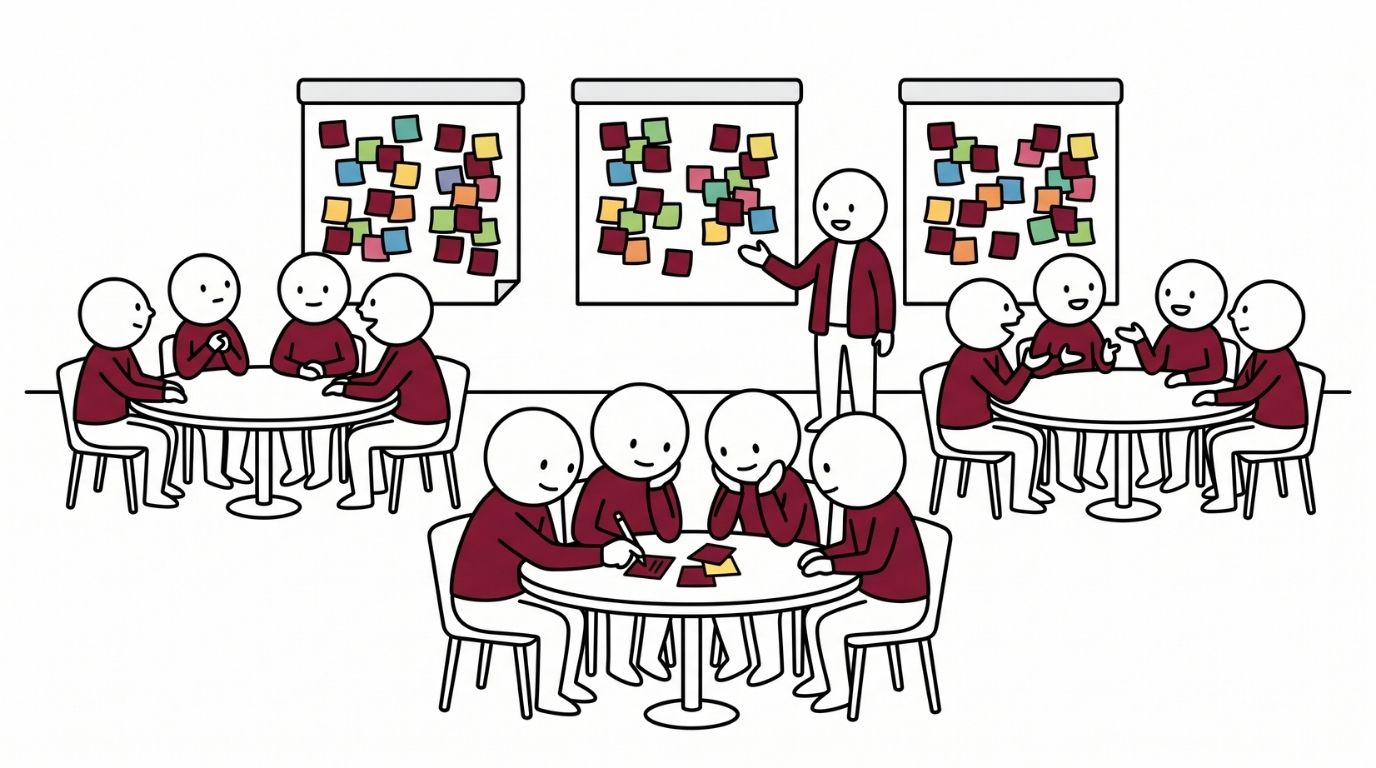
Give everyone sticky notes. One observation per note. The instruction is specific: facts only. What did you see, hear, or experience? No judgements, no interpretations.
This is where you will do the most redirecting. Someone will write "The communication was terrible." That is an interpretation, not an observation.
Ask them: "What specifically did you see that tells you the communication was terrible?"
The answer might be "The design team didn't receive the brief until two days before the deadline." That is an observation. It is specific. The group can work with it.
Small groups of four to six share and cluster their observations. Then each group gives the whole room their two or three most striking ones. You capture these on a flip chart headed "What?"
Spend time here. This stage always gets rushed because it feels obvious. It is the foundation for everything that follows.
Stage 2: So What?
Now the group can interpret. Point to the observations on the wall and ask:
- Why does this matter?
- What patterns do you see?
- What connections are you making?
This is the stage that changes the conversation. Groups that normally jump to action are forced make sense of it first.
You will hear things like "Three of these observations are about the same handoff point" or "We keep saying communication but actually it is timing."
Some groups will try to stay in Stage 1, adding more observations instead of interpreting.
Others will leap to Stage 3 and start proposing solutions.
Both times, redirect: "Good thought. Park it. We are in 'So What' right now. What does this pattern tell us?"
Stage 3: Now What?
Only now does the group decide what to do. And because they have done the work of separating observation from interpretation, the actions that come out are different.
They are specific. They connect to the patterns the group identified, not to the first idea someone had.
Push hard on specificity.
"Improve communication" is not an action. "Schedule a 15-minute handoff call between design and development every Monday at 9am, starting next week" is an action.
For each one, ask: who owns this, and when will it happen?
The logistics: 5 to 40 people (best with 8 to 25). Minimum 20 minutes for a quick debrief, 30 to 45 minutes typical. All you need is three flip chart sheets on the wall (one per question), markers, sticky notes, and a timer. Works brilliantly after any shared experience: a workshop activity, a project milestone, a difficult meeting, or a quarter-end review.
One thing to try on Monday: At the end of your next meeting or session, put 10 minutes on the clock. Ask the three questions in order. Do not let anyone answer "Now What?" until the group has spent at least 3 minutes on "So What?" That will change the quality of the actions you get.
→ Get the full What? So What? Now What? guide
Fishbone/Ishikawa — For Pro members
The problem it solves: The same issue keeps coming back. The group has fixed it before, or thinks it has, but here it is again.
Customer complaints rising. Deployment failures. Missed handoffs. The quick fixes worked for a month and then the pattern returned.
There is a root cause problem. The group has been treating symptoms because they have never systematically mapped all the possible causes.
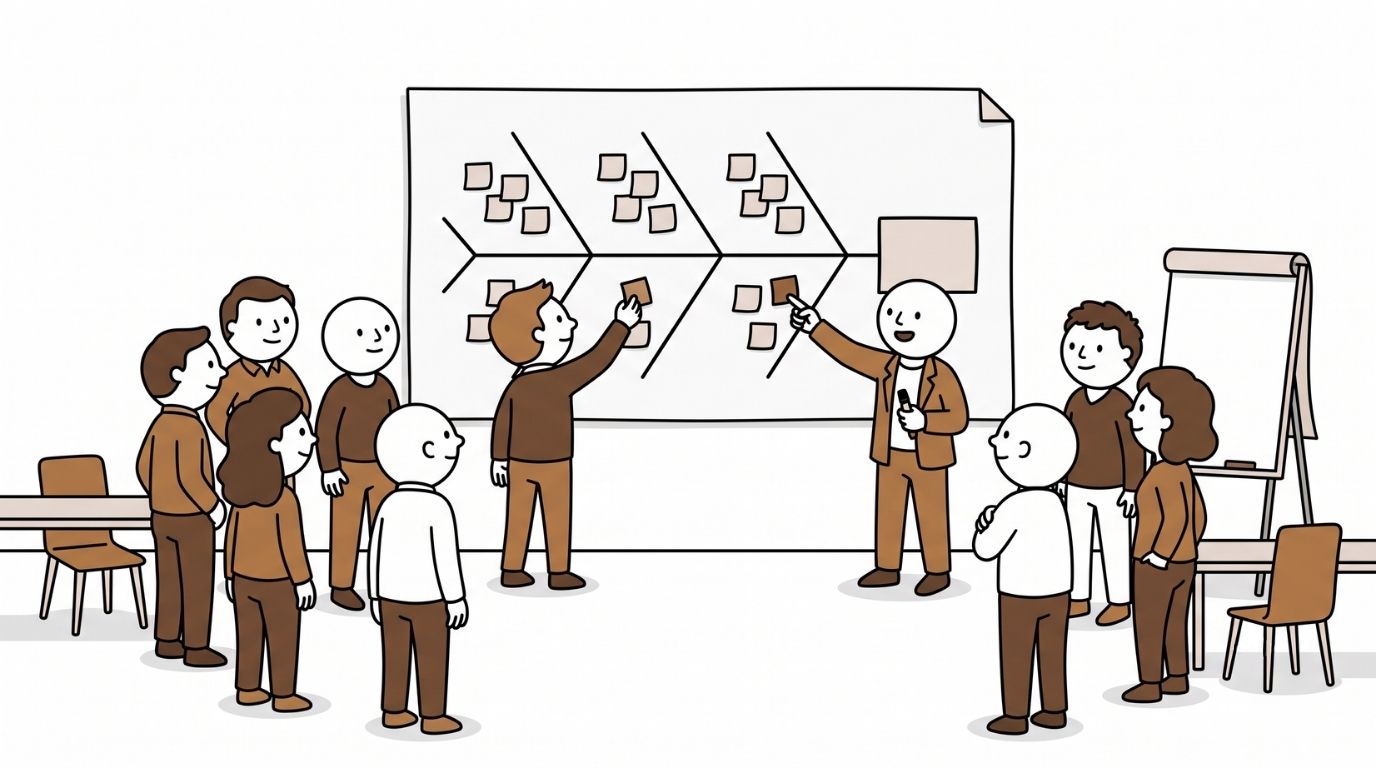
A Fishbone session puts the problem at the head of a visual diagram shaped like a fish skeleton. The group then works through cause categories one at a time: People, Process, Technology, Environment, Communication, Policy.
For each category, they brainstorm every possible contributing factor and attach it to the diagram as a bone.
Left to their own instincts, most groups fixate on the cause that matches their existing theory.
The person from IT says it is a technology problem. The manager says it is a people problem.
The category framework forces everyone to look at all six dimensions before settling on an answer.
The depth comes from one question the facilitator keeps asking: "Why does that happen?"
Someone says "Staff don't follow the procedure."
You ask why. The answer might be "The procedure takes 20 minutes and they have 10."
That is a different cause with a different solution. The fishbone pushes past the obvious layer to what is actually driving the problem.
The full guide in the Pro library covers the complete process from problem statement design through brainstorming, review, and prioritisation, plus adaptations for virtual delivery, small and large groups, and a quick 20-minute version.
These two techniques are a natural pair.
Use W³ for the quick reflection after a meeting, a workshop, or a project milestone.
If the "So What?" stage reveals something deeper (e.g. a pattern the group cannot explain) that is when you bring in the Fishbone.
Twenty minutes of structured reflection to find the signal. Ninety minutes of root cause analysis to trace it to its source.
313 techniques in the library. Two more this week. Every one built to the same standard: step-by-step process, facilitator scripts, failure modes, virtual adaptations, and real-world examples.
→ See what is inside WorkshopBank Pro
Questions? Send me a message using the Contact Us link in the footer. I reply personally.