
You know the moment.
The brainstorm has been running for twenty minutes. The flip chart has twelve sticky notes on it. Eight of them are variations of things the group tried last quarter.
Someone suggests "what about a workshop?" and three people nod. Not because it's a good idea, but because the silence was getting uncomfortable.
The room isn't out of ideas. It's out of different ideas.
This week I added three new techniques to the WorkshopBank library.
All three solve the same problem: what to do when a group's thinking has gone stale.
One is free. Two are inside the Pro Membership.
This week's free technique:
Forced Connections
This is the technique that sounds ridiculous until you run it.
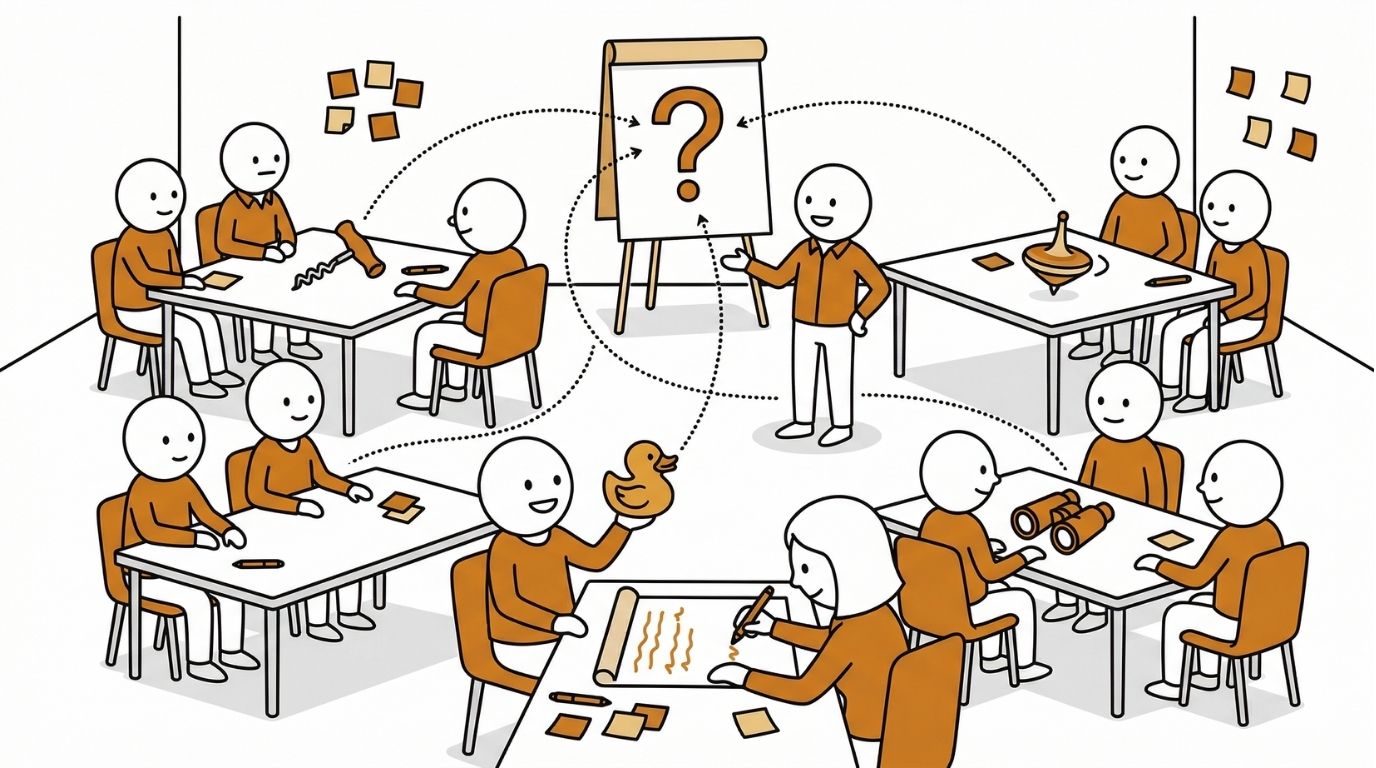
You give each table a random object. A rubber duck. A kitchen whisk. A pair of binoculars. Something that has nothing to do with the problem they're working on.
Then you ask them to list its attributes. What does it do? How does it feel? What is it made of? How does it move?
Then the actual work: take each attribute and force a connection to the problem.
If the object is a rubber duck and one attribute is "floats," the question becomes: what if our onboarding process floated? What if it adapted to whatever situation the new starter was in, rather than following a fixed path?
That sounds absurd. And that absurdity is exactly why it works.
When you brainstorm normally, your brain follows familiar neural pathways and lands on familiar ideas.
A random stimulus forces you off those pathways.
Your brain has to make sense of something that doesn't fit, and in doing so, it makes connections it would never have made on its own.
How to run it (30 minutes, groups of 4 to 30):
-
Frame the challenge. Read the problem statement aloud.
-
Hand each table a random object. Give them 3 minutes to list at least 8 attributes. Push them past physical descriptions: "What does it do? What does it remind you of?"
-
Force connections. 12 to 15 minutes. Take each attribute and ask: "How could this connect to our challenge?" One idea per sticky note. Aim for 10+ per table.
-
Share. Each table picks their 3 most interesting connections (not safest, not most practical, most interesting) and presents in 2 minutes.
-
Develop. Dot vote on the top ideas, then spend 5 minutes answering: "What would it take to make this work?"
One thing to watch: Don't skip the attribute step. Without it, people make surface-level connections only. The attributes create the entry points for real creative thinking.
→ Read the Forced Connections guide on WorkshopBank
Also new in Pro this week
When the group keeps circling the same ideas because nobody's questioning the starting assumptions.
Assumption Busting
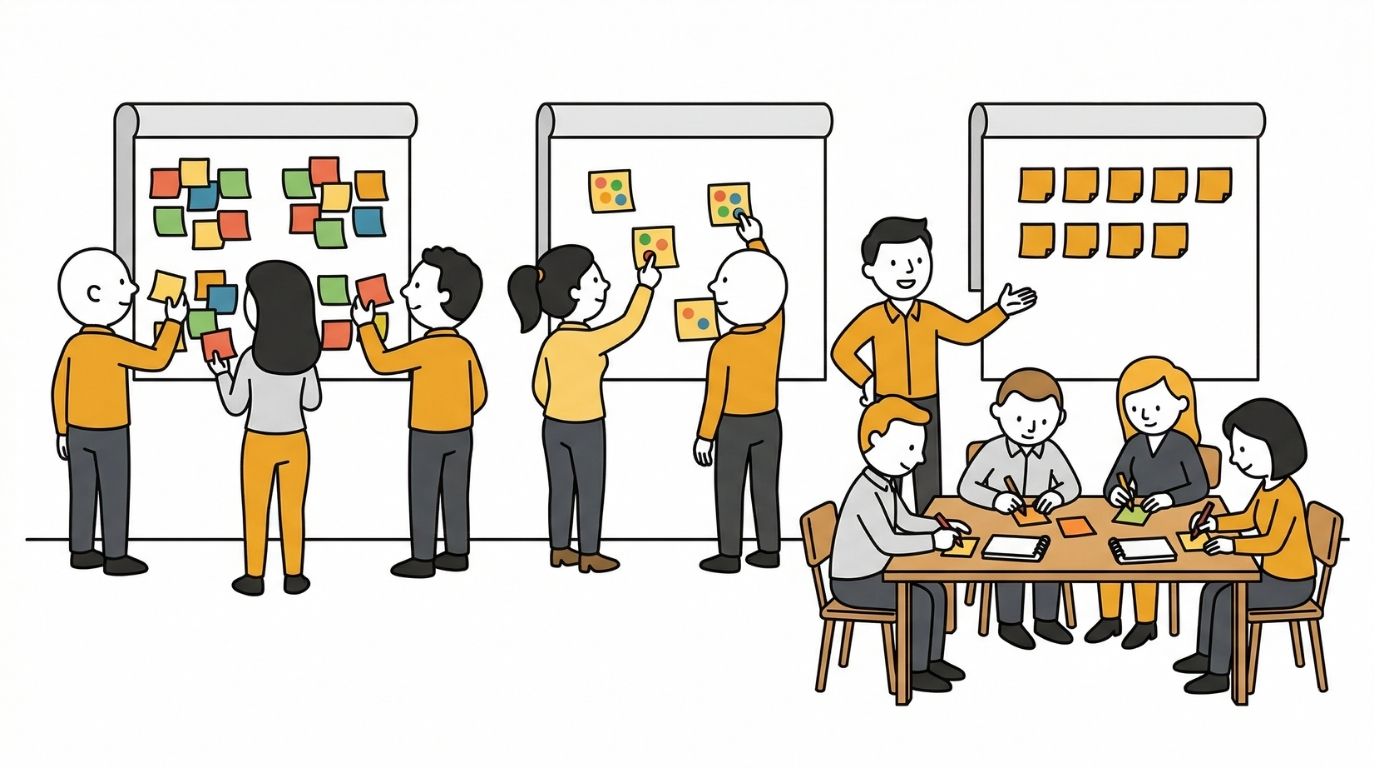
Assumption Busting surfaces the hidden beliefs a group holds about a problem, then systematically challenges each one: "What if this weren't true?"
The result is a set of possibilities the group would never reach through normal brainstorming, because normal brainstorming stays inside the boundaries that assumptions create.
A SaaS product team used this to challenge 22 assumptions about their pricing model.
One challenged assumption revealed that their annual contract customers churned at the same rate as monthly customers, just in larger batches.
That single insight reshaped their entire retention strategy.
→ See the Assumption Busting guide
When you need a large group to generate and rank ideas in under 30 minutes
25/10 Crowd Sourcing
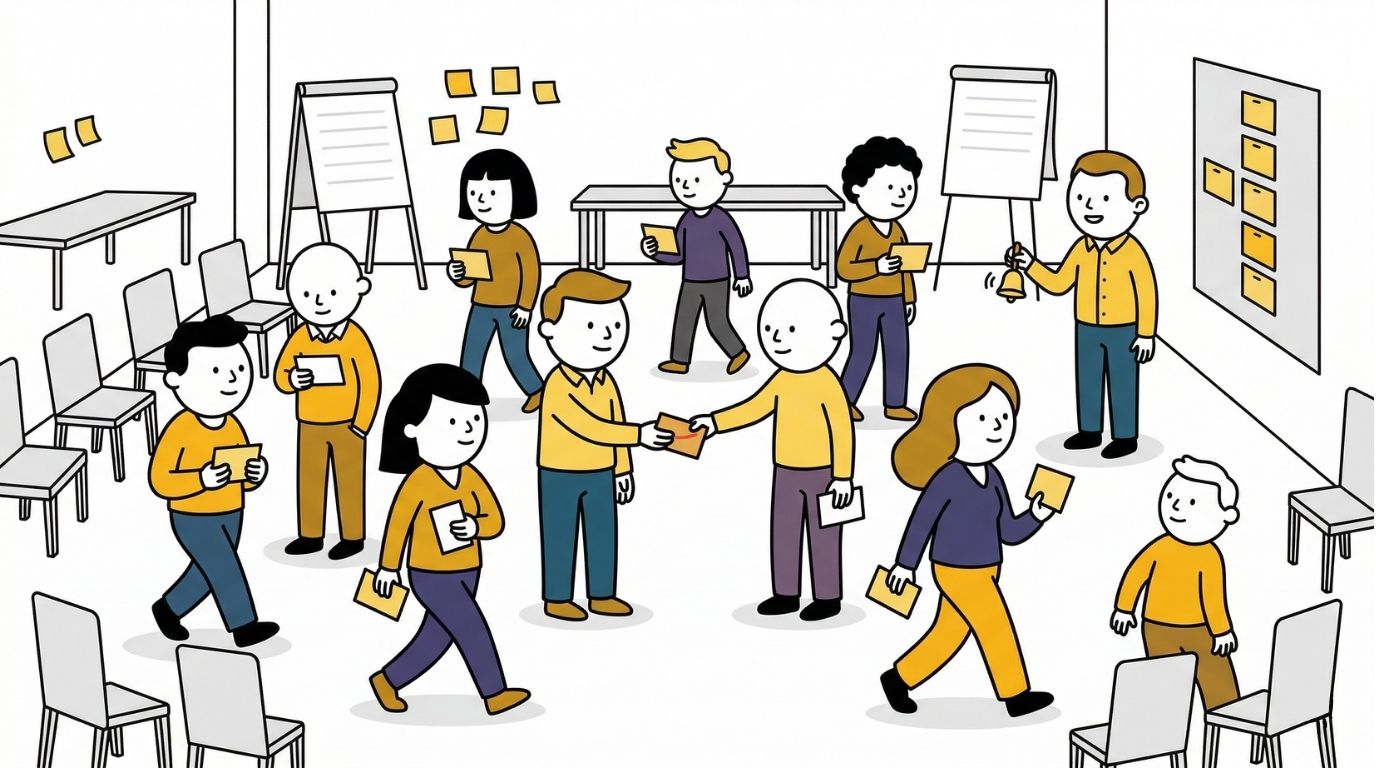
25/10 Crowd Sourcing gets everyone on their feet.
Each person writes a bold idea on an index card, then the room mills around passing cards from person to person.
You call "stop," each person scores the card in their hand from 1 to 5, and you repeat for five rounds.
Add up the scores, call them out from the top down, and the room's best ideas surface in less than half an hour.
Anonymous, physical, and impossible to dominate.
A conference organiser used it with 150 attendees at the end of a two-day event. The Top 10 became the published conference commitments.
→ See the 25/10 Crowd Sourcing guide
This week's additions are part of the Facilitation Techniques bundle in WorkshopBank Pro.
The bundle covers ideation, decision-making, dialogue, large group methods, and more, with new techniques added every week.
→ See everything inside WorkshopBank Pro
Questions? Send me a message. I read every one.
See you next week.