
Someone says "let's brainstorm."
You know what happens next. You've been in this room before.
One person says the obvious idea. Everyone nods. A second person says a version of the same idea with different words. The sticky notes start going up. Fifteen minutes later there are forty of them on the wall and they all say roughly the same three things.
The quiet people haven't spoken. The weird ideas haven't surfaced. And the group is about to pick the safest option on the wall because nobody pushed past the first thing that came to mind.
Brainstorming isn't broken because people lack creativity. It's broken because the format rewards whoever talks first, talks loudest, and talks longest. The interesting ideas (the strange ones, the risky ones, the ones that need a few seconds of courage to say out loud) stay in people's heads.
This week I released four techniques into the Facilitation Techniques Bundle. All four sit in the Generative & Creative category. All four are built for the moment a standard brainstorm runs out of oxygen.
One of them is free. And it starts by asking the group to do something that sounds completely wrong.
Reverse Brainstorming
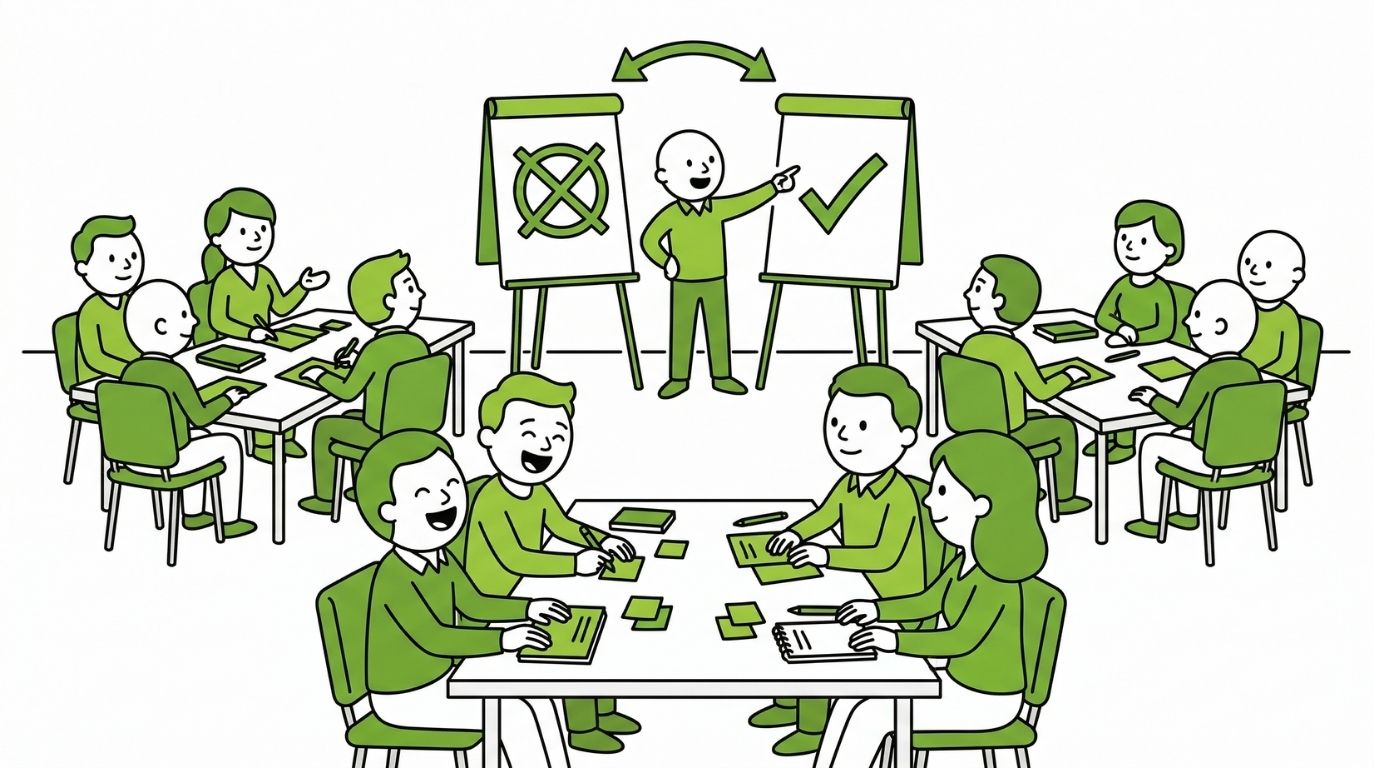
Stop trying to solve the problem. Instead, ask your group this: "How could we make this problem worse?"
You flip the question. And the moment you do, something shifts in the room.
When you ask people to solve a hard problem, they freeze . They filter. They hedge. They wait for someone more senior to go first.
But when you ask them to cause the problem, to guarantee failure, the pressure disappears. People laugh. They compete to come up with the most ridiculous suggestions.
A room that was cautious three minutes ago is now shouting ideas over each other.
"How could we guarantee new starters have the worst onboarding experience?" gets you a list like: delete all the documentation, assign them a manager who's on holiday, give them the wrong laptop, don't introduce them to anyone, and make sure nobody checks in for the first month.
If you've started a new job recently, some of those probably sound familiar. The reverse ideas hold up a mirror to what's already happening. The group sees it without anyone having to point fingers.
Then you flip each idea into a solution.
"Delete all documentation" becomes "audit and update the onboarding docs before every new starter."
"Don't check in for a month" becomes "schedule daily fifteen-minute check-ins for the first two weeks."
The solutions aren't revolutionary. But they're specific, they're honest, and the group arrived at them through laughter instead of blame.
The technique traces back to 1958, when Charles Whiting described a "Reversal-Direct Method" in his book Creative Thinking.
It also draws on Alex Osborn's brainstorming principles from the late 1930s, particularly the idea that judgement kills ideas and volume beats quality.
Reverse Brainstorming takes both principles and adds a twist: it's easier to generate volume when you're not trying to be right.
It works with 4 to 30 people. You need 30 minutes minimum, 45 to 60 is better.
Flip chart paper, sticky notes, markers. No special materials, no pre-work, no complicated setup.
You can run this in a Tuesday afternoon meeting with whatever's already in the room.
One warning: don't spend so long on the reverse phase that you rush the flip. The bad ideas are fun. The room will want to stay there. But the value is in the solutions, not the comedy. Protect at least as much time for flipping and prioritising as you give to the reverse round.
→ Download the Reverse Brainstorming technique
Three more tools went live this week. Each one is a different answer to the same question: what do you do when a standard brainstorm isn't producing anything worth building on?
Brainwriting
The meeting has a loudmouth problem. Not malicious, just one or two people who think out loud and fill all the space.
The quieter half of the group has stopped trying to get a word in. They have ideas. They've just learned there's no gap to say them in.
Brainwriting removes speech from the equation.
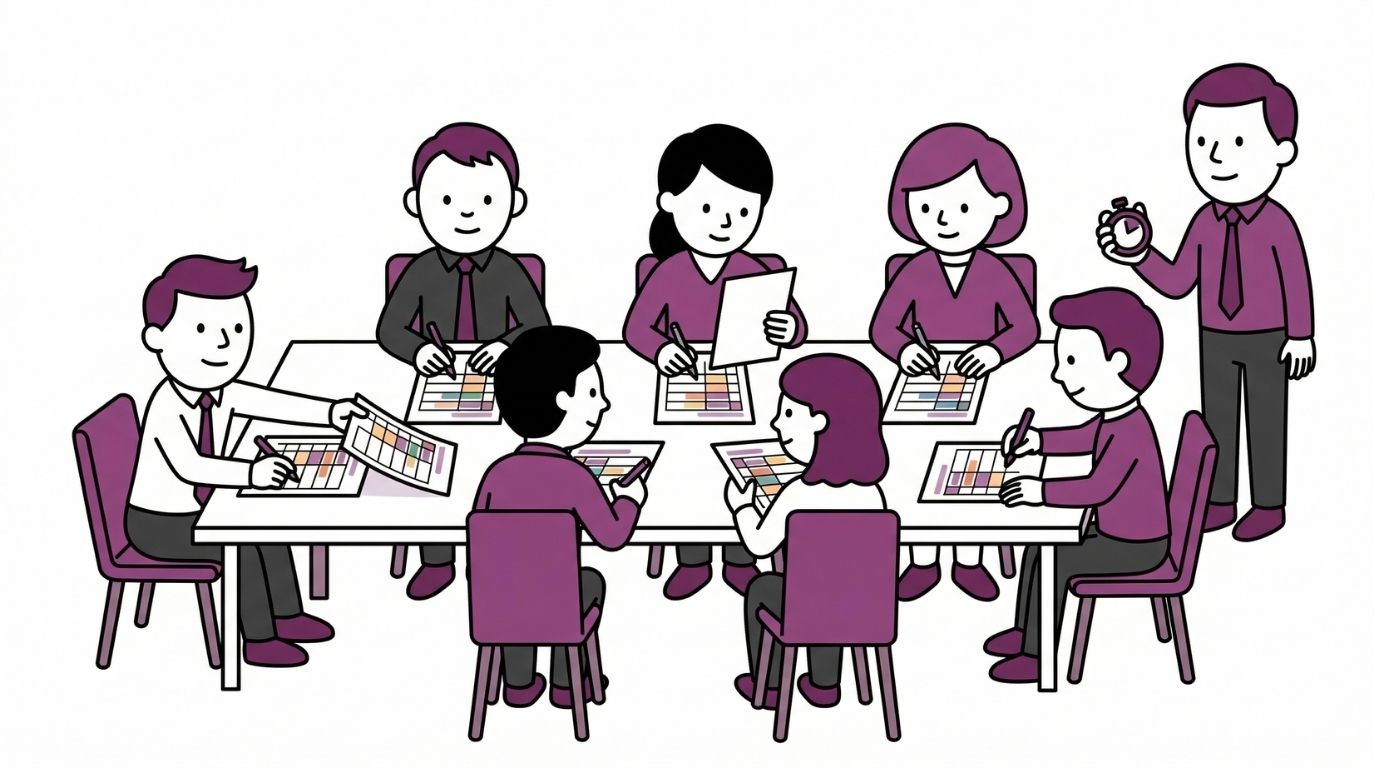
Everyone writes three ideas on a sheet of paper in five minutes, then passes their sheet to the next person.
That person reads what's there and adds three more. This continues for several rounds. Nobody talks during the writing.
The result: a group of six people produces up to 108 ideas in 30 minutes. More importantly, the ideas build on each other in ways that conversation rarely allows, because each round adds a new perspective to what came before. The junior person's idea gets the same space on paper as the director's.
It was designed in 1968 by Bernd Rohrbach as a direct fix for the dominance problem in verbal brainstorming. Fifty-seven years later, that problem hasn't gone away.
→ Get the full Brainwriting technique
Crazy 8s
The team has been talking about ideas for an hour. There are words on a whiteboard. Everyone roughly agrees on a direction.
But nobody has made anything concrete, and the conversation keeps circling because abstract ideas are easy to agree with and impossible to compare.
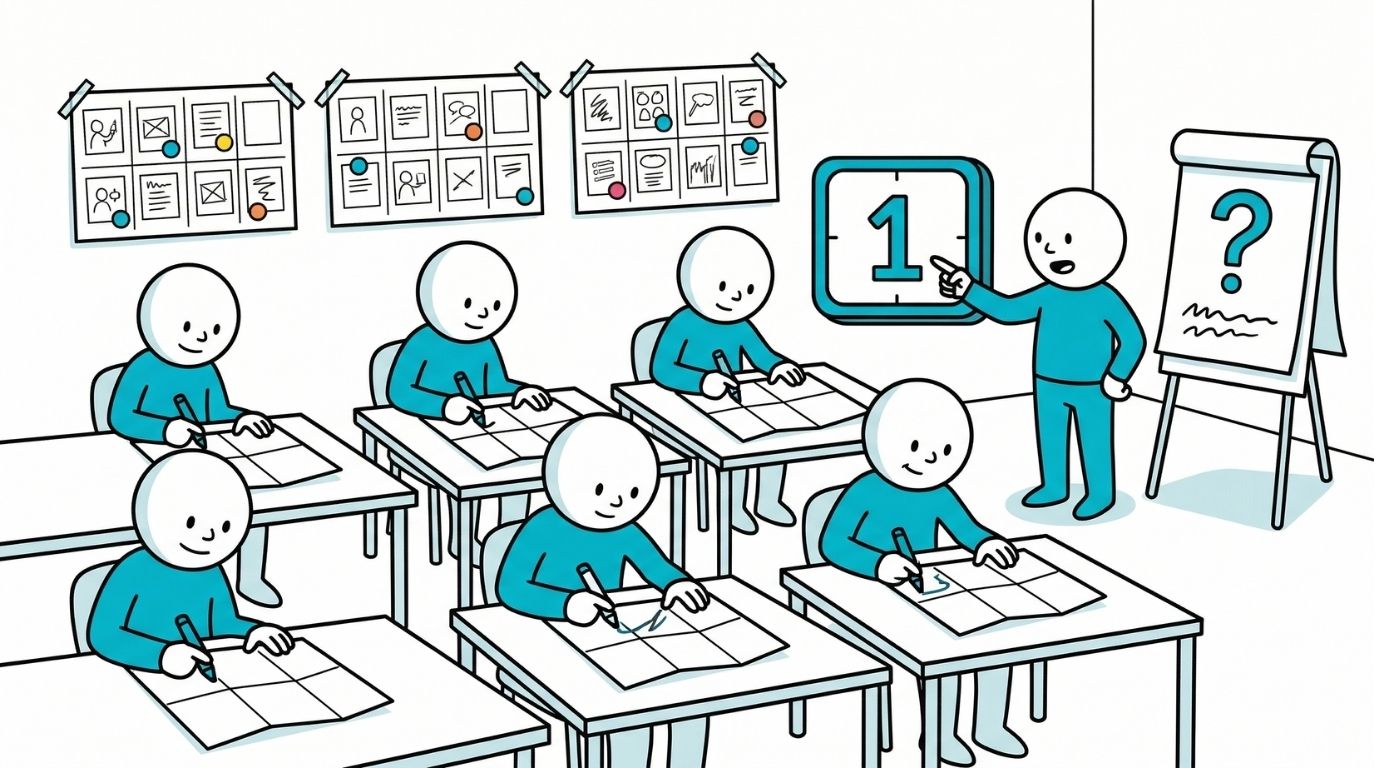
Crazy 8s forces ideas out of the air and onto paper. Each person folds a sheet into eight panels and sketches one idea per panel.
One minute each. Eight minutes total. No artistic skill required.
Boxes, arrows, stick figures, and labels are the whole visual language.
The constraint is the point. Your first idea is the obvious one. By panel four, the obvious answers are used up. Panels five through eight are where the strange, interesting, actually-worth-testing ideas tend to appear.
The technique was popularised by Jake Knapp as part of the Google Ventures Design Sprint, and it's the fastest way to turn a vague group conversation into something you can point at, compare, and vote on.
→ Get the full Crazy 8s technique
SCAMPER
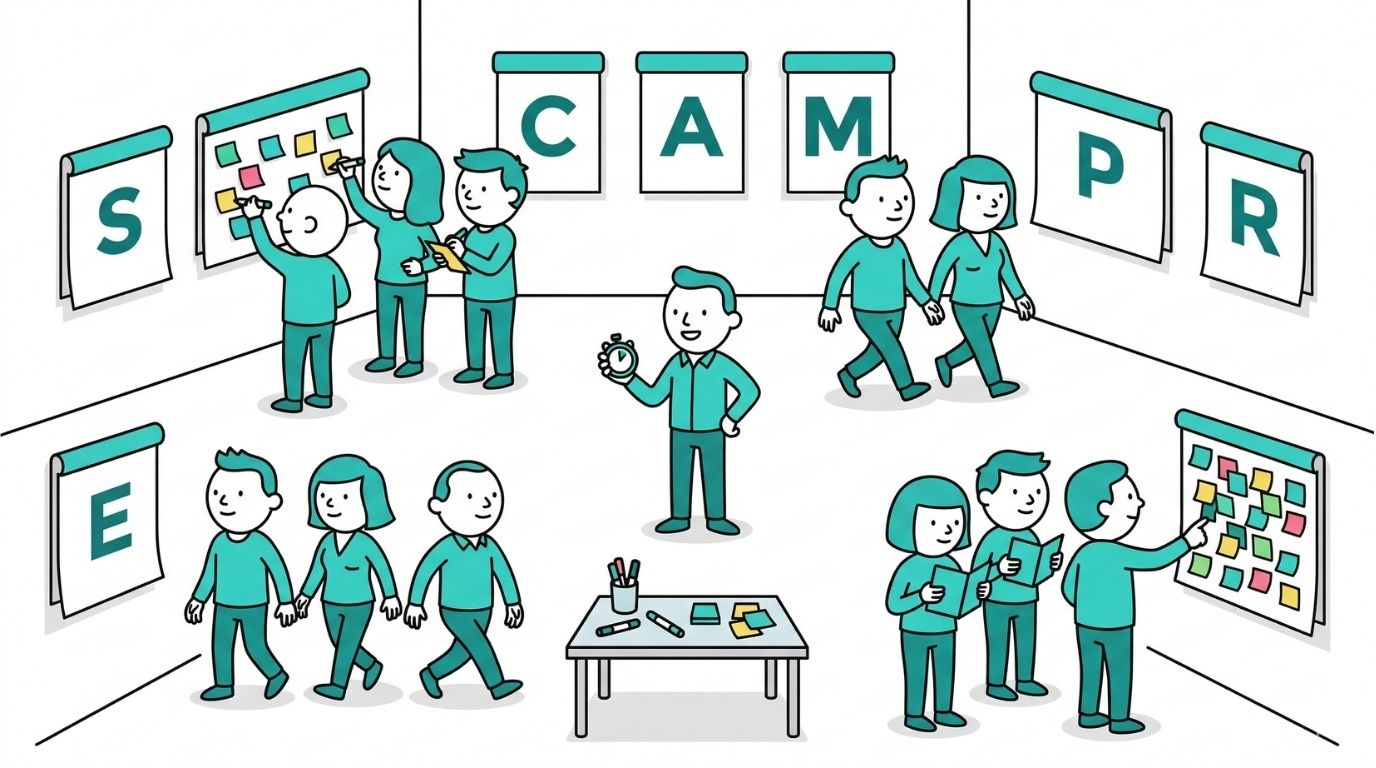
You're not starting from scratch.
You have an existing product, process, or service and the group needs to improve it.
But every suggestion sounds like a small tweak on what already exists, because everyone is anchored to the current version.
SCAMPER gives the group seven forced perspectives: Substitute, Combine, Adapt, Modify, Put to other uses, Eliminate, Reverse.
Each one is a different question applied to the same subject. "What could we remove entirely?" produces different ideas than "what could we combine?" which produces different ideas again from "what if we reversed the order?"
The structured rotation through all seven lenses means the group covers creative territory they'd never reach in an open brainstorm, because each lens forces a different kind of thinking.
Bob Eberle built it in 1971 from Alex Osborn's original checklist of creative prompts, and it remains one of the most practical ideation tools you can run with a group that doesn't think of itself as "creative."
→ Get the full SCAMPER technique
These four are part of the Generative & Creative Group section of the Facilitation Techniques Bundle.
→ Explore the full Facilitation Techniques Bundle
The WorkshopBank library now has 265 techniques.
Each one written the same way: when to use it, when not to, step-by-step process, facilitator notes, common mistakes, adaptations, real examples.
If you grab the free Reverse Brainstorming technique this week, try it on a problem your group has already brainstormed the normal way.
Same problem, flipped question. See what comes out that didn't come out before.
If you try one email me tell me how it went. I read every reply.