
The most honest conversation in your workshop happens over coffee 20 minutes later.
You've asked a good question. The room goes quiet. Then someone gives you the safe answer. The one that sounds right but says nothing.
Everyone nods. Someone adds a slight variation of the same safe answer. More nodding.
And you can feel the real response is sitting behind their eyes. The thing they'd say to a colleague over coffee. The thing they'd text to a friend on the way home. But it's not reaching the room.
The problem isn't that your group won't talk. It's that you're asking them to use words for things that words aren't good at.
This week, I've added three techniques to the WorkshopBank library that solve this in different ways.
All three replace talking with showing.
And all three work because they give people a way to express what they already know but can't quite articulate.
Visual Explorer / Photo Cards
(free technique — download available for a limited time)
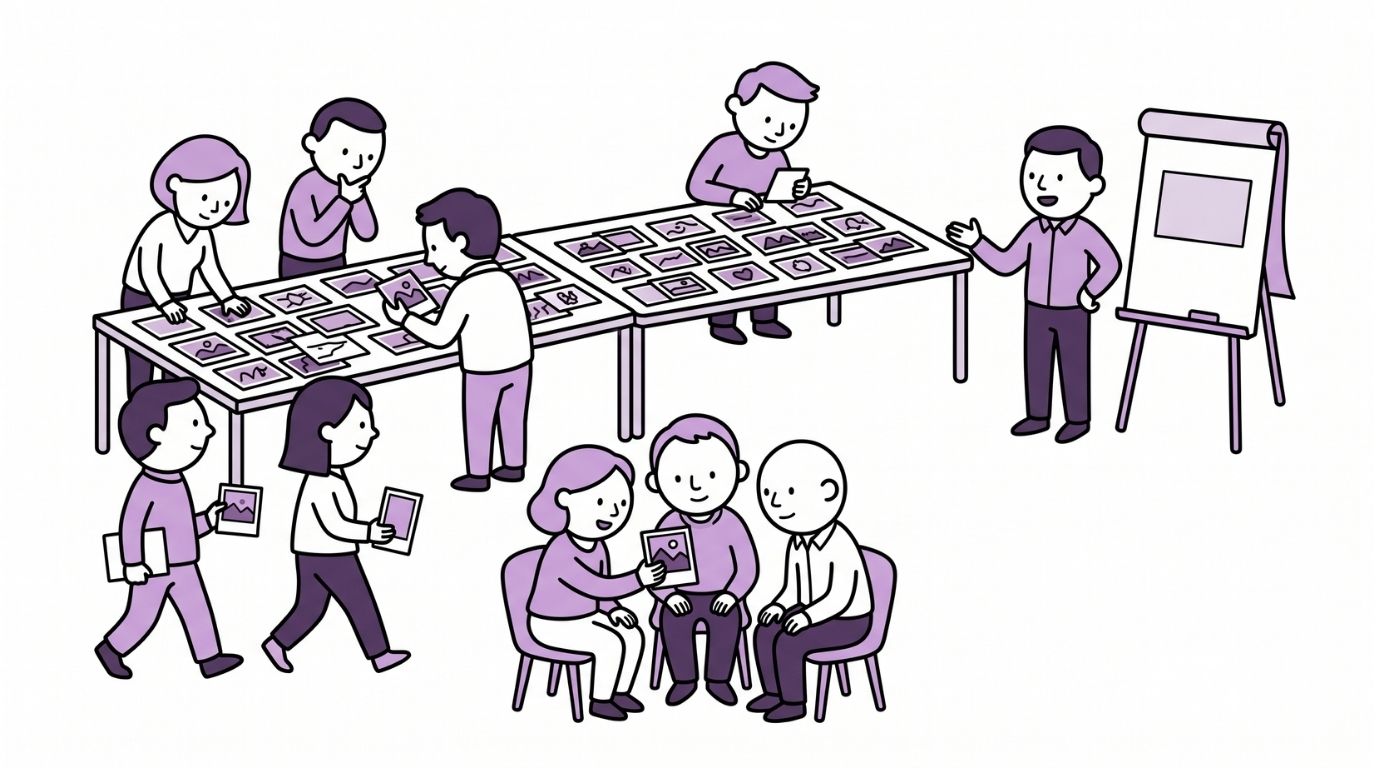
Here's the concept. You spread a collection of images across a table.
Photographs, postcards, magazine clippings, printed pictures.
Anything visual and varied.
Then you ask the group a single framing question connected to the real work: What does our team culture feel like right now? or What are we not talking about?
Each person browses in silence, picks the image that resonates, and brings it back to a small group of three to five people. Then they hold up their image and explain why they chose it.
That's when it happens.
Someone holds up a photo of a stormy sea and says: "This is what our team feels like right now."
Someone else picks a picture of a locked door.
Another person chooses an image of a bird in a cage and talks for four minutes about autonomy and control.
None of those sentences would come out in a normal meeting. The image makes it possible.
The reason is what facilitators call the "third object" effect.
The image sits between the speaker and the group.
It's the picture that's stormy, not the person who's being negative.
It's the door that's locked, not the person who's being difficult.
That distance makes honesty safer.
Try a lightweight version this week:
-
Collect 30-40 images. Postcards, magazine pages, printed photos. Mix landscapes, people, abstract images, objects. Include images that feel uncomfortable, not just pleasant ones.
-
Write a framing question on a flip chart. Make it open and meaningful. "What does success look like for this project?" works. "What do you think?" doesn't.
-
Spread the images on a table. Ask the group to browse in silence and pick one that connects with the question. Give them five minutes. Protect the silence.
-
Form groups of three to four. Each person shares their image: what they see in it, why they chose it, how it connects to the question. Three minutes per person.
-
Debrief with the whole group. Ask: "What patterns did you notice?" and "What surprised you?"
The full technique guide covers
- The setup needed for groups of 4-30 people
- The facilitator moves that deepen the conversation
- How to handle the person who says "I don't know why I picked this one"
- Adaptations for virtual delivery
- Five real-world applications including one where a single image unlocked a 40-minute coaching conversation that had been circling for months.
→ Download the full Visual Explorer guide (free for a limited time)
New for Pro Members this week
Brown Paper Planning
The problem it solves: The plan lives in one person's head. Or worse, in a spreadsheet that three people have access to and nobody follows. The rest of the team can see their own tasks but not how their work connects to anyone else's.
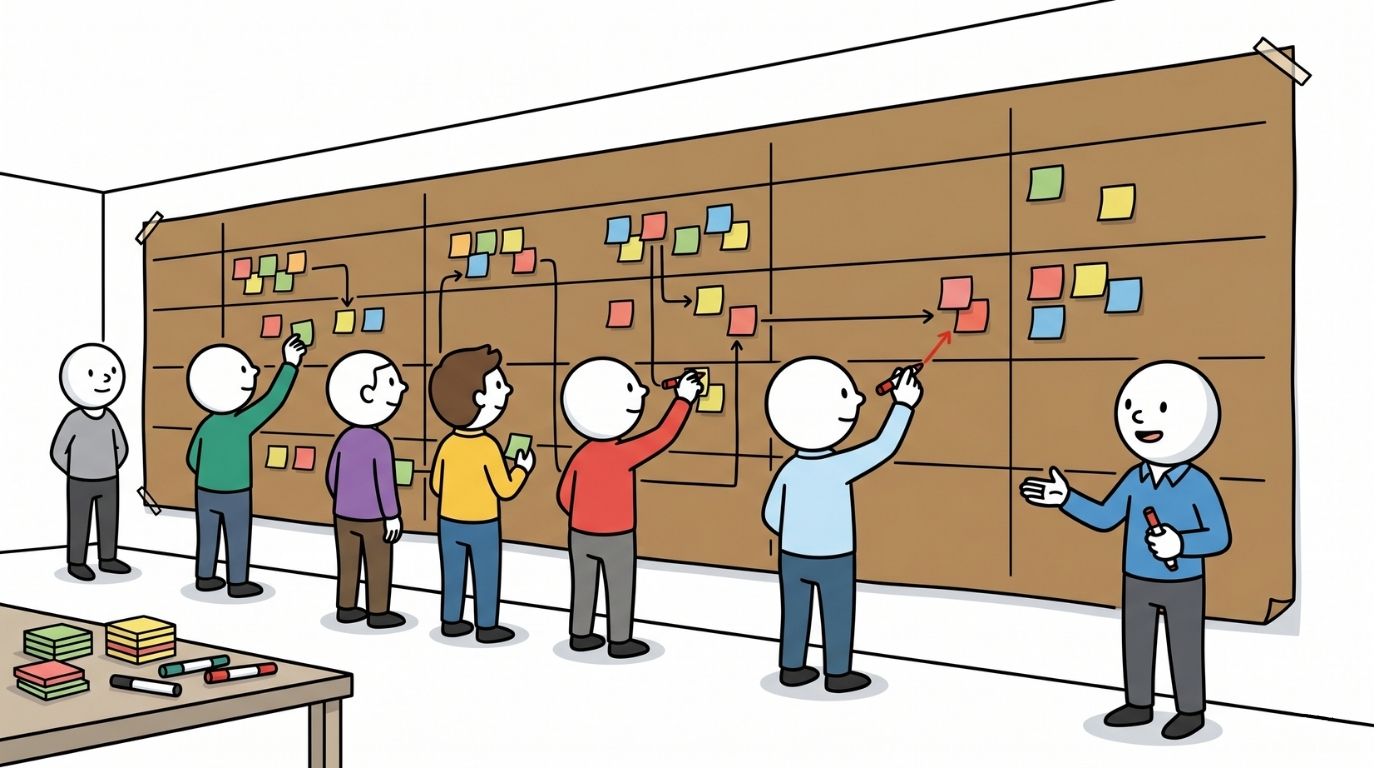
Brown Paper Planning fixes this by rolling out a long sheet of paper on a wall, drawing a timeline and swim lanes, and having the whole group build the plan together with sticky notes and markers. Everyone writes. Everyone places. Everyone sees the dependencies, the gaps, and the pressure points at the same time.
The full guide covers the five-step process from framing through dependencies and risk identification, how to handle groups of 4-15 people, and the facilitator moves that stop one person from dominating the pen.
→ Read the full Brown Paper Planning guide
Storyboarding
The problem it solves: The group agrees on the destination but nobody has mapped the steps between here and there. The transitions, handoffs, and decision points are invisible because words skip over them.
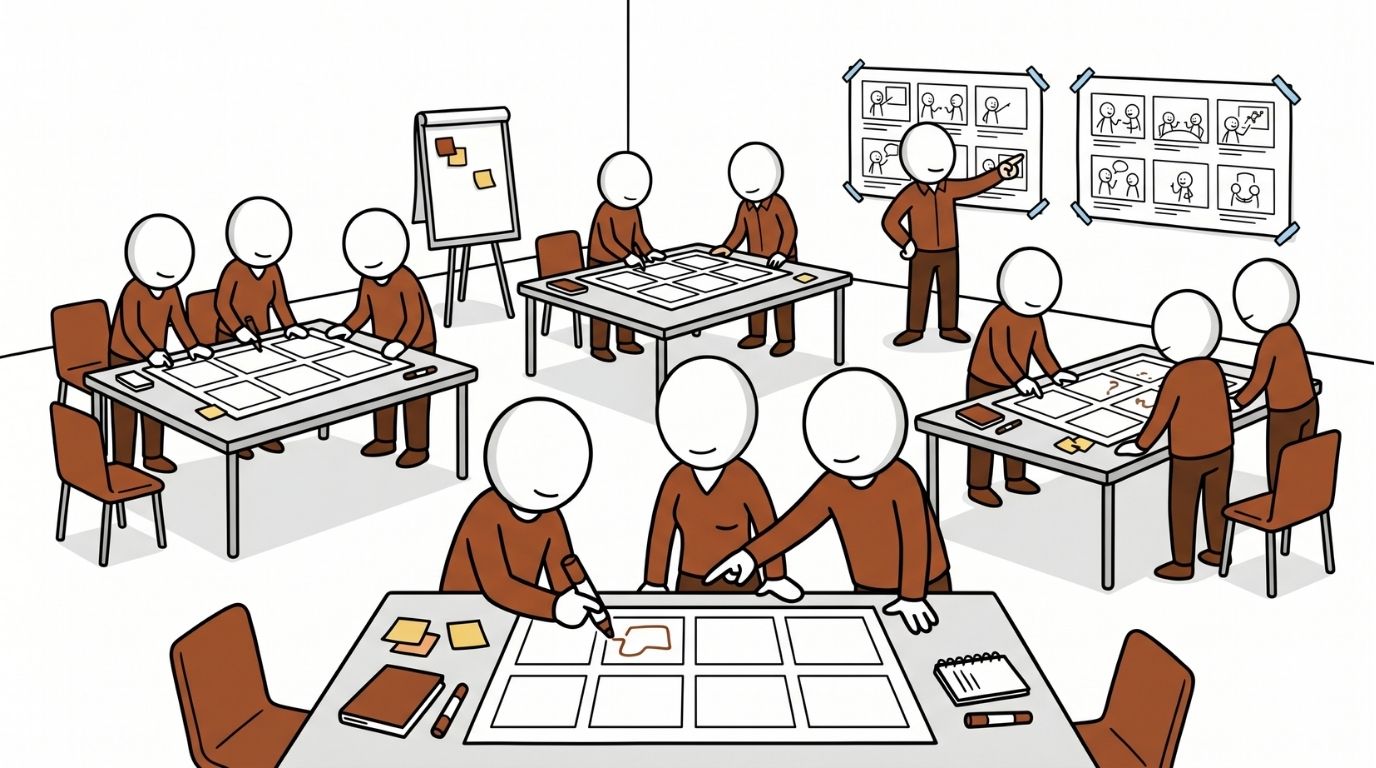
Storyboarding makes the group draw the journey in six to eight panels, like a comic strip. Start state in the first panel. End state in the last. Then fill the middle. Every gap between two panels is a question: What happens here?
The full guide walks through the five-step process including the key facilitator move of anchoring the last panel before filling the middle, how to run a gallery walk across multiple storyboards, and adaptations for virtual delivery and groups up to 30 people.
→ Read the full Storyboarding guide
Join Pro for consultant-grade workshops
The WorkshopBank Pro library now has 285 techniques across every category. Each one is a full facilitator guide: what it is, when to use it, when not to, the step-by-step process, common pitfalls, and real-world applications.
If you're building sessions and you want consultant-grade techniques as your starting point instead of a blank page, Pro gives you that.
→ Sign-in for free and see everything inside WorkshopBank Pro
Questions about membership? Send me a message. I reply personally.